
CX+AI
Blog, podcast and vlog
What the book argues, worked out in pieces that stand on their own. On AI as a multiplier, customer focus that actually sticks, and what you do with it on Monday.
What the book argues, worked out in pieces that stand on their own. On AI as a multiplier, customer focus that actually sticks, and what you do with it on Monday.
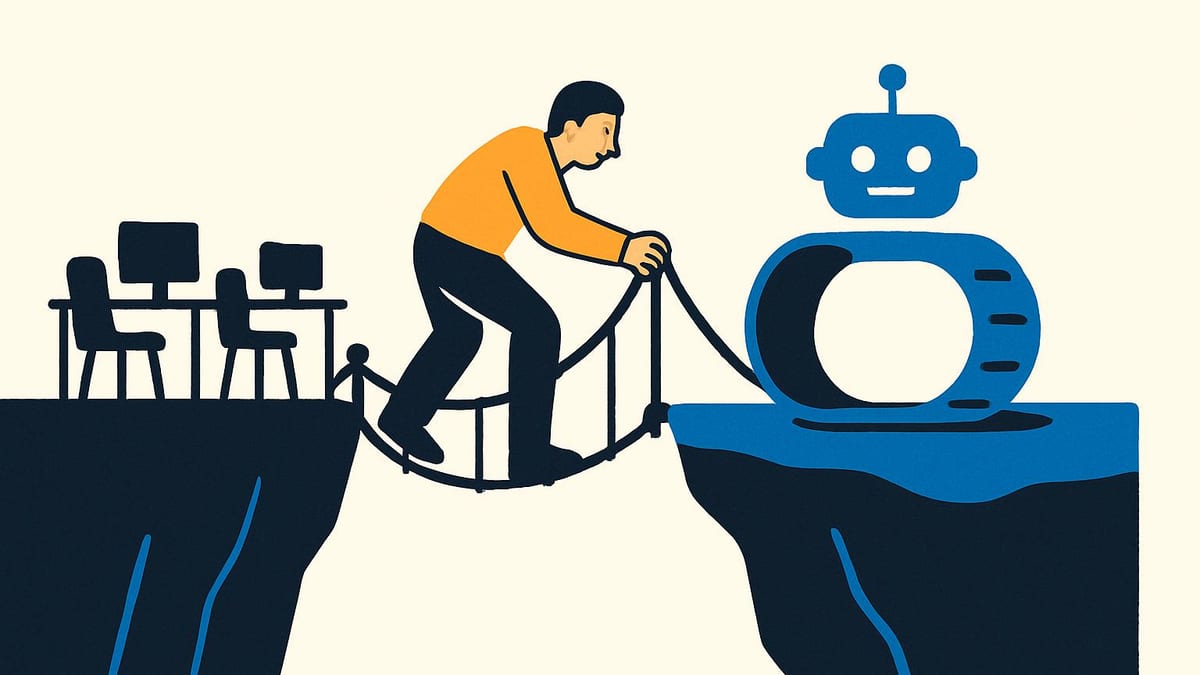
Part 2 of 2. Sinch surveyed 2,527 senior decision makers in early 2026 and found that 74 percent of enterprises with a live AI customer agent had pulled it back. Among the most mature governance teams the rollback rate ran to 81 percent, because they were the ones looking at their own output.
ReadNewArticlePart 2 of 2. Sinch surveyed 2,527 senior decision makers in early 2026 and found that 74 percent of enterprises with a live AI customer agent had pulled it back. Among the most mature governance teams the rollback rate ran to 81 percent, because they were the ones looking at their own output.
 Article
Part 1 of 2. Commonwealth Bank of Australia said its AI voice bot cut call volumes by 2,000 a week, then put 45 customer service jobs back in August 2025 after calls rose instead. The bot worked; the routing problem behind it did not.
Commonwealth Bank of Australia replaced 45 customer service roles with an AI voice bot, then watched call volumes rise and asked the staff to come back. The technology worked fine. The handover to a human was never designed.
 Article
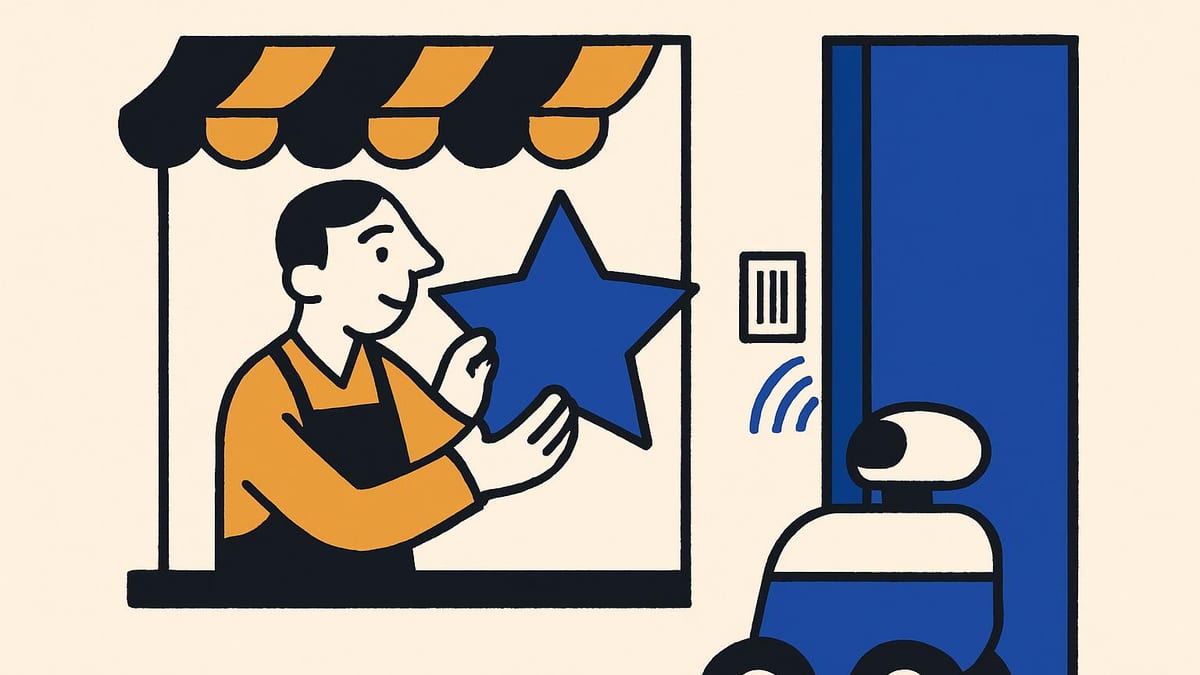
Walmart put about 200,000 products into ChatGPT and saw conversion three times lower for in-chat purchases than for shoppers who checked out on its own site, while roughly twice as many new customers arrived through ChatGPT. The facts an assistant reads about your products usually sit in a feed someone exported years ago.
 Article
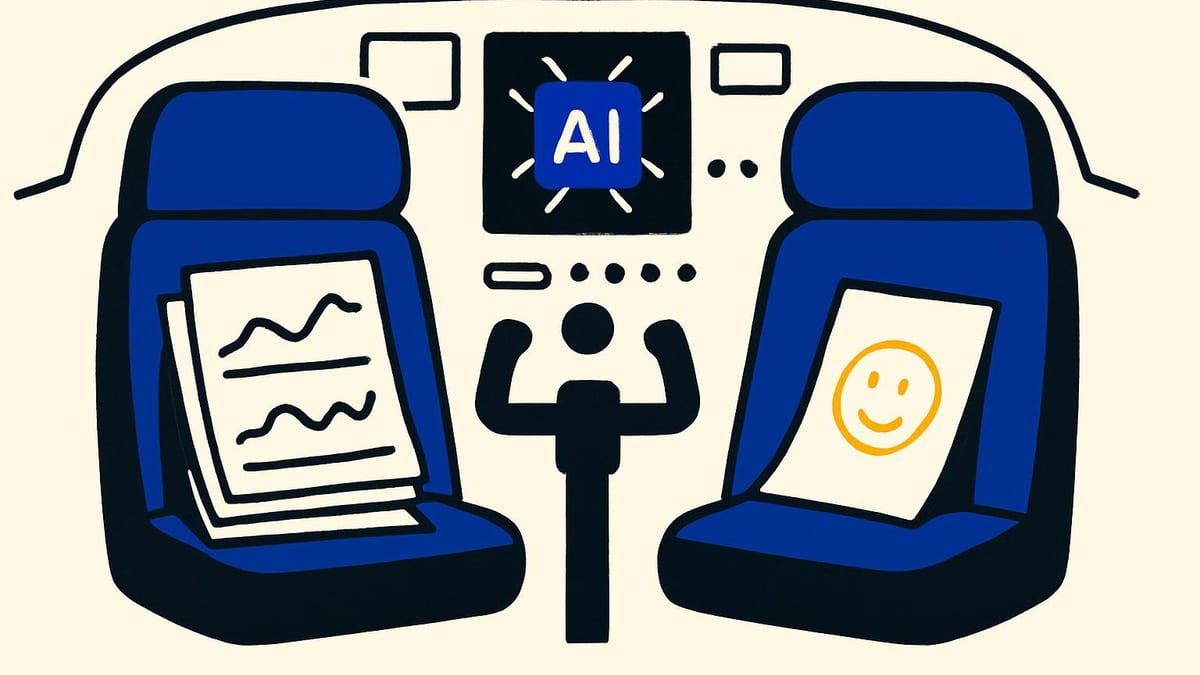
Klarna said its AI assistant did the work of 700 agents, and by May 2025 its CEO told Bloomberg the company was hiring human support back because quality had dropped. The assistant did what it was asked; the question behind it was written wrong.
 Article
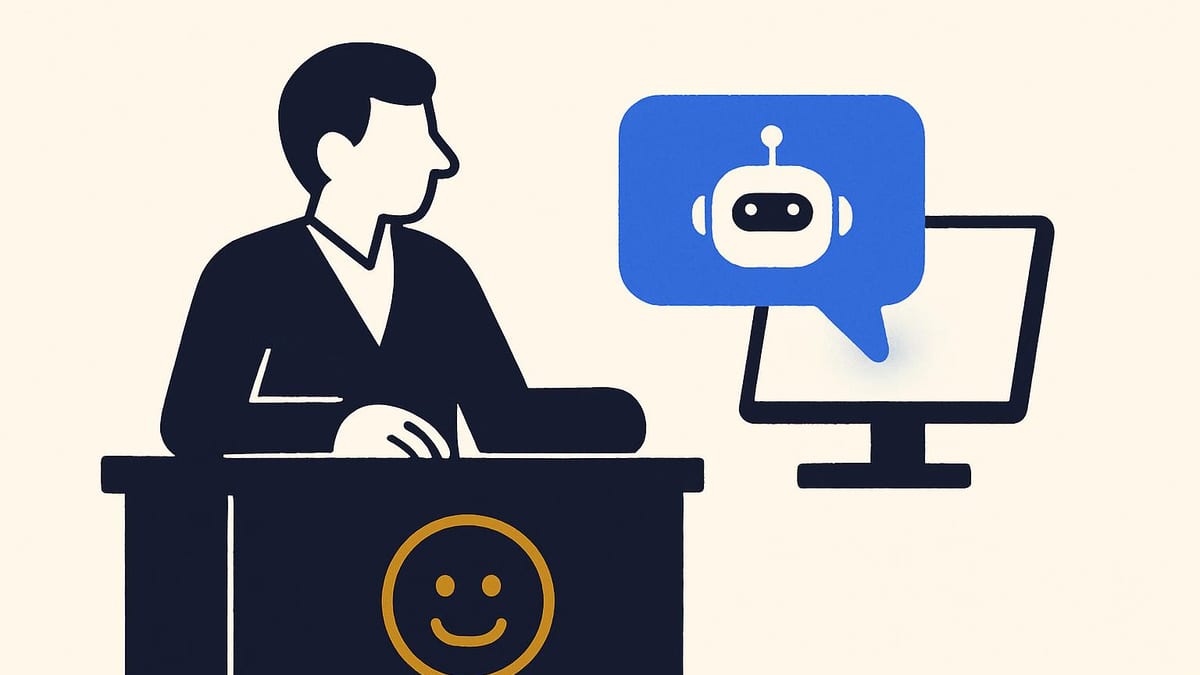
A tribunal in British Columbia made Air Canada pay C$812.02 because its website chatbot described a refund rule the airline did not offer. The amount is small; the principle is that an answer given on your behalf is an answer you own.
 Article
EXL asked 322 C-suite leaders where they stood: 76 percent believed they were ahead of the competition, roughly 10 percent actually were. The gap between what you think your level is and what the evidence shows is the most useful number you can put on the board table.
 Article
Part 1 of 2. On 5 October 2026 a shopper posted a screenshot: Walmart's defence against shopping agents had blocked him, a human, from signing in. One login screen, one lost sale, one brand that now reads as closed.
 Article
Commonwealth Bank of Australia replaced 45 call centre roles with voice AI in 2025 and reinstated the staff within weeks. Sinch found that 74 percent of enterprises with a live AI customer agent have already rolled one back, and the rate is higher among the best-governed ones.
 Article
In February 2024 Klarna said its OpenAI assistant was doing the work of 700 agents, with resolution times down from 11 minutes to under 2. Fifteen months later the same CEO told Bloomberg the strategy had gone too far and human service was worth reinvesting in.
 Article
Challenger counted more than 150,000 AI-attributed layoffs in the first six months of 2026, while Gartner asked 321 customer service leaders and only about 20 percent said their workforce had shrunk. The announcements and the operations are describing two different years.
 Article
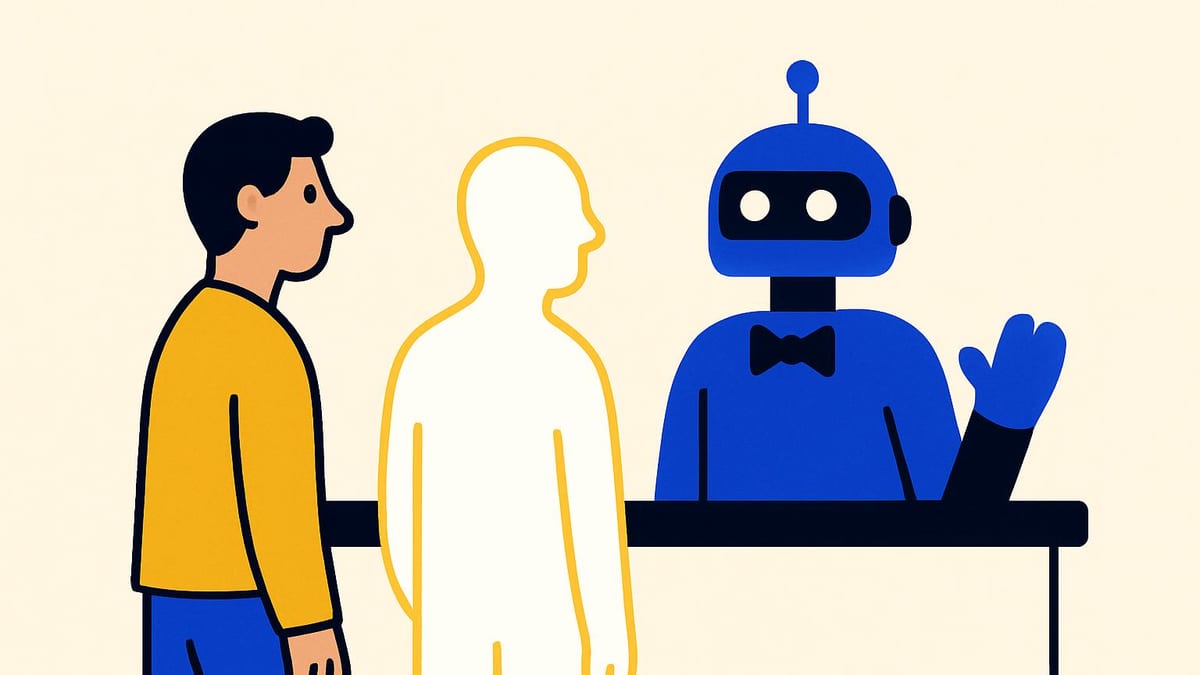
A board asks one question about AI: are we behind? Nobody can answer it, because technology, market and your own maturity move as three separate curves, and only the third one belongs to you.
 Article
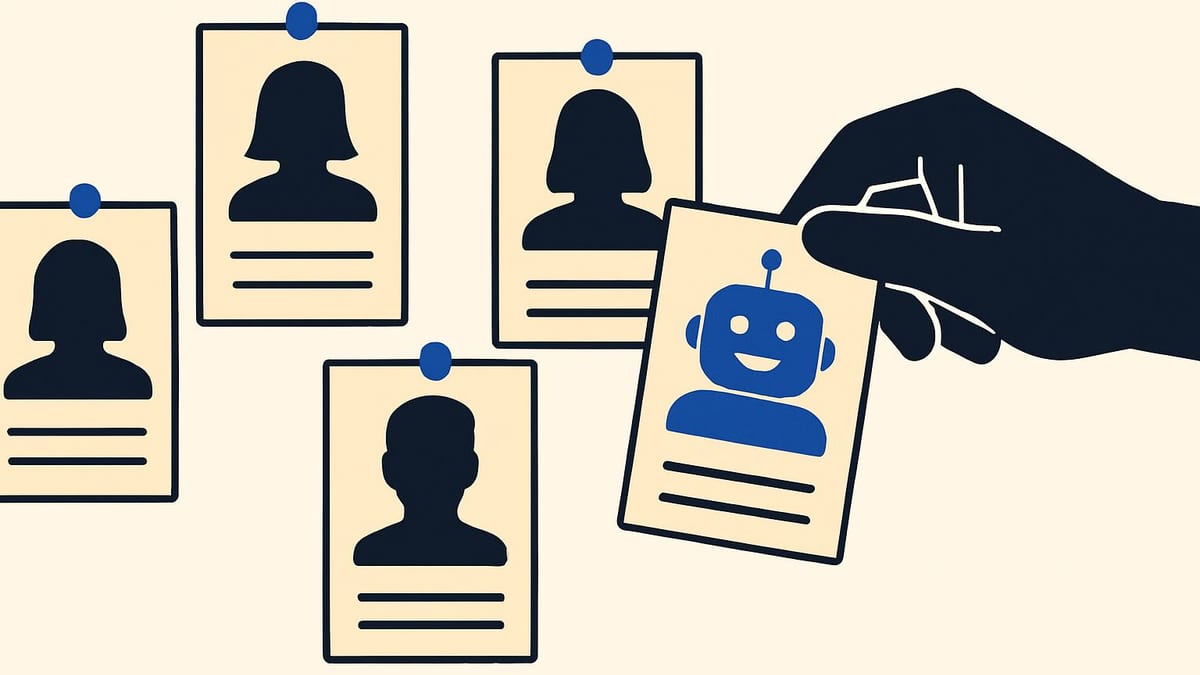
A kitchen showroom owner wanted to know which of his twelve form fields broke the quote. The real question was who was reading the form, because the first visit to his business is increasingly made by an agent on someone's behalf.
 Article
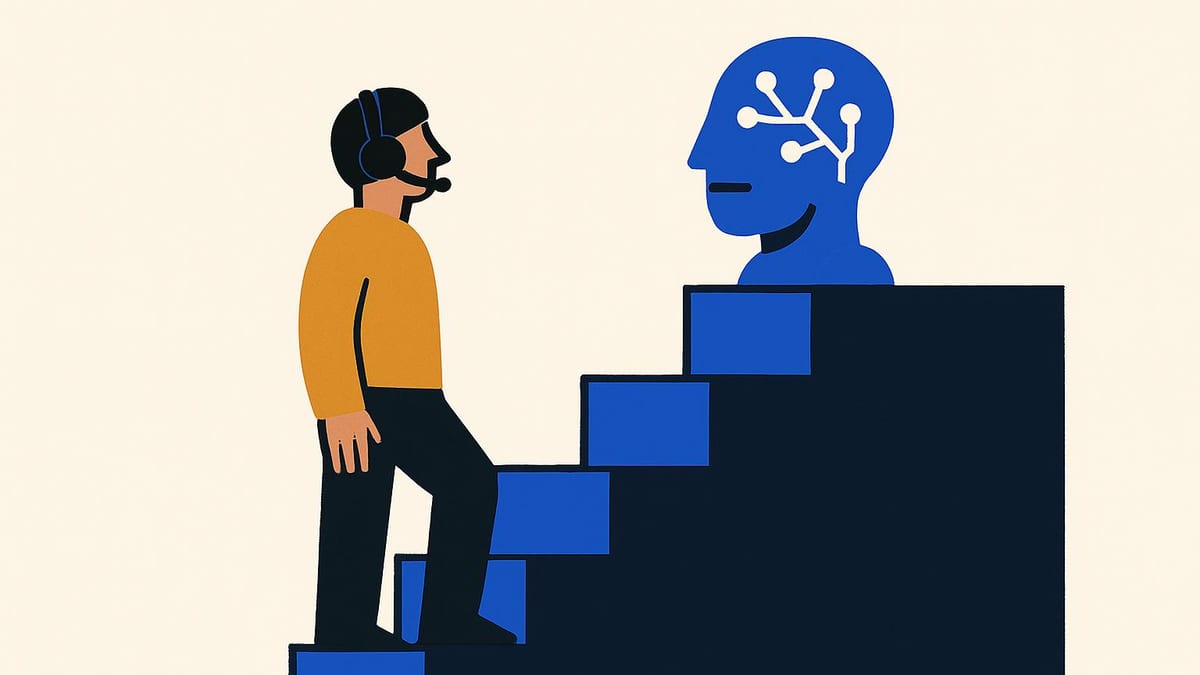
A journey team split the new chat entry point in two in four minutes: the young persona got the AI assistant, the older one got a phone number. The personas on the wall were a year old, and adoption had moved since.
 Article
Part 2 of 2. Five levels, four climbs, and four out of five organisations stop at the third one. Most of what the transformation roadmap asks happens on the floor, in the hands of the person who runs the daily stand-up.
 Article
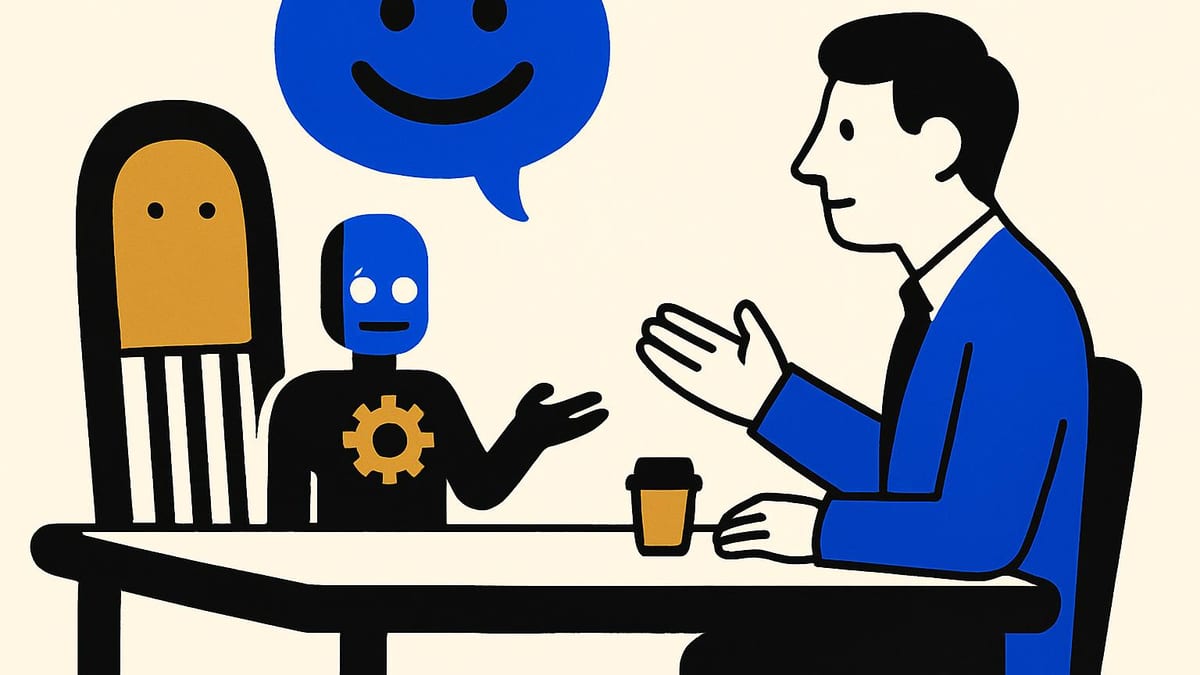
Part 1 of 2. Two dates tell you whether your AI transformation is real: the day a capability became available, and the day it ran safely in production. Most boards cannot produce either date within an hour, and four in five organisations stop at the third climb.
 Article
Take your three most enthusiastic people off the project for a month and watch what happens to the work. Whatever keeps running is your transformation, and the rest was enthusiasm.
 Article
Two companies buy the same platform in the same month, and twelve months later one of them sees nothing. The difference sits in what the tooling was multiplying: a journey somebody owns, data somebody trusts, a decision a team is allowed to make.
 Article
A chat assistant had been running for over a year, customers used it, nobody turned it off, and no line on the profit statement had moved. MIT found roughly 95 percent of pilots show no effect on profit, and the cause sits in the learning gap.
 Article
A customer asked an assistant which supplier could deliver before Friday. The assistant never loaded the page, found no delivery time in the data, and recommended someone else. No bounce, no complaint, nothing to look at.
 Article
Five in six customers have to repeat themselves when a conversation moves from AI to a person. That handover is the cheapest repair in your journey, and almost nobody fixes it first because it sits between two teams.
 Article
Part 2 of 2. A chatbot at Air Canada told a customer about a bereavement discount the airline did not offer, and the tribunal held the airline to it. The fix is one page per service request: what the agent approves alone, what it hands over, and who signs off when the boundary moves.
 Article
Part 1 of 2. Air Canada's chatbot told a customer about a bereavement discount the airline did not offer. The customer acted on it, and the tribunal ruled the company was bound by what its own system had promised.
 Article
The demo works, the model answers, and the customer journey looks the same in December as it did in January. IDC found that roughly 88 percent of proofs of concept never reach broad rollout, and the thing that blocks them sits in the process, not in the model.
 Article
Three quarters of the AI licences organisations pay for stay unused, while actual usage of self-chosen tools runs two to three times higher. The seats are empty because one block under the tool was never built.
 Article
Elin moved house and her assistant compared eleven suppliers in nine minutes, leaving her two options and about forty seconds of attention. The brand director's largest budget lines buy attention from an audience that was never in the room during that comparison.
 Article
A neighbour bought a dishwasher in eleven minutes at her kitchen table, from three options an assistant handed her. Among American consumers, 35 percent now start product discovery inside an AI tool, against 13.6 percent in a search engine.
 Article
A business owner wrote the saving per ticket into one spreadsheet cell and asked when the AI assistant pays for itself. That cell prices a tool, while the money sits in the rate of improvement over the twelve months after go-live.
 Article
Layoffs attributed to AI passed 150,000 in the first half of 2026, while Gartner asked 321 customer service leaders and only about 20 percent had actually cut headcount. The announcements and the payroll are two different documents.
 Article
Part 2 of 2. Need, generation, psychology, channel and trust, life moments: the five lenses still hold. Behind each one sits a second reader, a machine working for your customer, and passive adoption runs roughly three times ahead of active.
 Article
Part 1 of 2. A complaint that reads like it came from a law firm was written by a woman in logistics, on her phone, with help. Every message reaching your service desk now passes two readers, and one of them is a machine.
 Article
The persona labelled "wants reassurance, prefers to call" now arrives at step one with a comparison already made and a summary of her own terms. The research behind that label was fielded over a year ago.
 Article
Block forty minutes on Monday and do one real task of your own with AI, start to finish. The three things that get in the way are the list your transformation runs on, and your team already knows whether you have ever opened the tool.
 Article
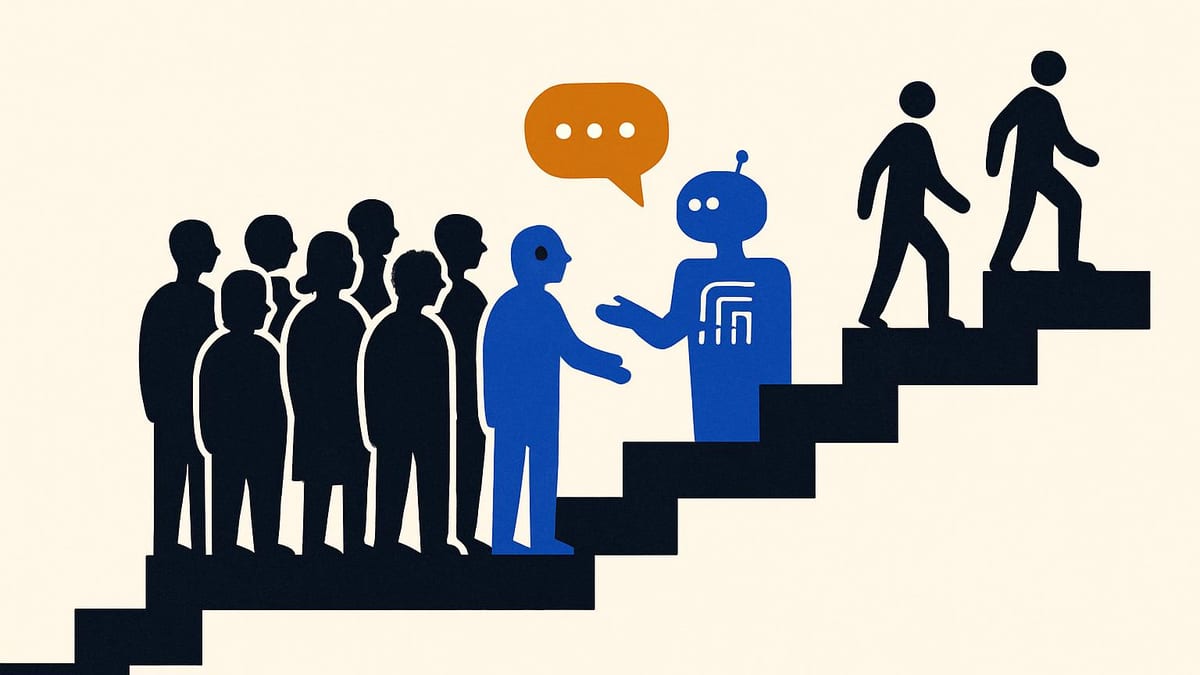
Deciding on AI takes weeks. Connecting data and governance takes six to twelve months. Redesigning processes and becoming callable by machines takes one to two years, and four out of five companies stop there, because the climb outlives the attention that launched it.
 Article
Your sector decides at what height you start the climb, and your delegation gradient decides your speed. A team lead who can start a test this week learns in days; a company that waits for a monthly steering committee learns four times a year.
 Article
Sales writes proposals with AI, a planner cleans up route lists, and someone in finance built a formula only she can explain. Meanwhile the management team is still discussing a kickoff after the summer, and that gap is where the old change plan comes apart.
 Article
The demo answers three questions beautifully, the room nods, and then someone asks what happens at the handover. Within four messages the customer is explaining the situation again and the goodwill is gone.
 Article
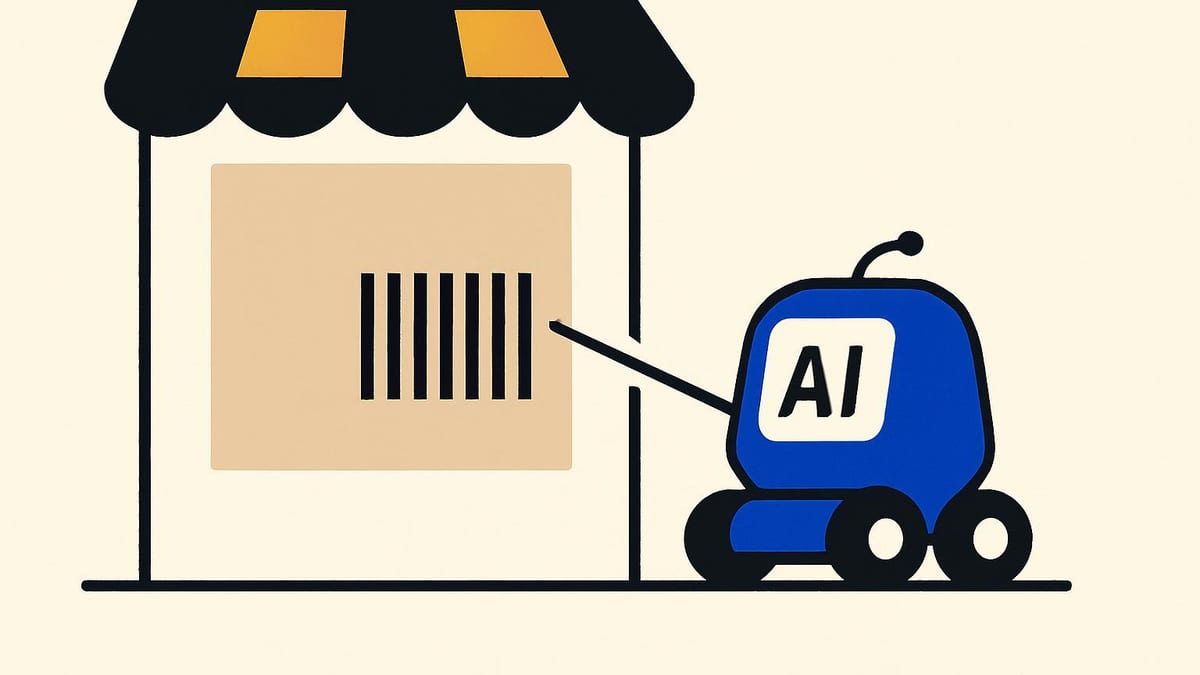
Part 2 of 2. An agent cannot see your brand, it can only read it. Colour and typography carry nothing into a generated answer; product attributes, service rules and claim boundaries do, and someone has to own that file.
 Article
Part 1 of 2. The brand guidelines have an owner, the campaign has an owner, the website has an owner. The feed an agent reads on behalf of your customer usually has nobody, and that gap decides whether you get retrieved at all.
 Article
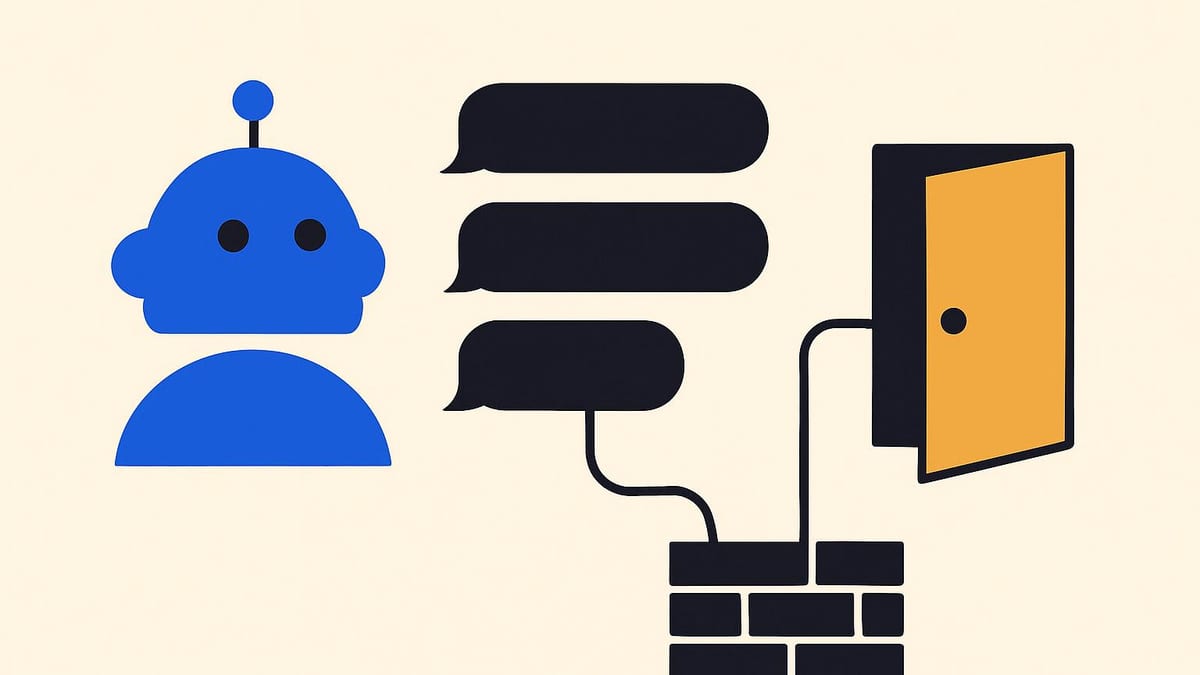
Nearly three in ten consumers call AI the most frustrating part of dealing with a company, and two thirds would rather solve the issue themselves. Same people, same week, and the visible route to a person is what makes the automated path work.
 Article
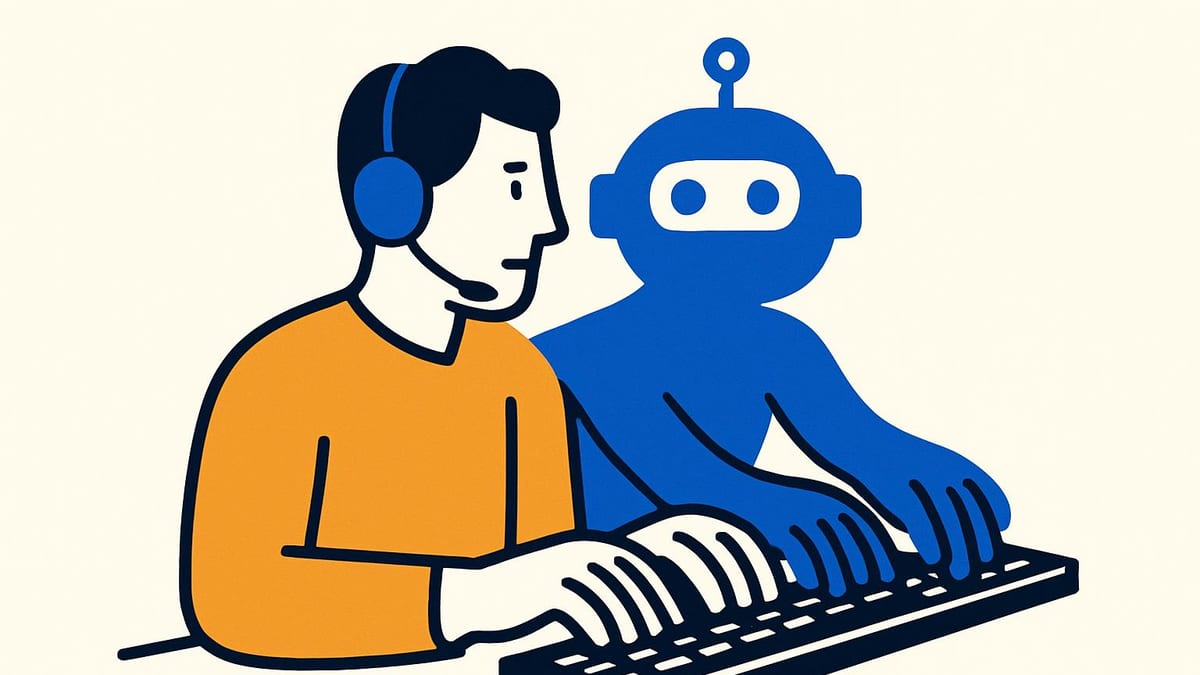
Exploration asks you to throw thirty-seven directions away. AI hands you twelve more, each with a plausible paragraph attached, and the team spends three weeks reading instead of choosing.
 Article
A chatbot told a customer about a bereavement discount the airline did not offer, and the tribunal held the airline to the promise. Every organisation with an agent in front of a customer now carries that same exposure, at a volume no manager can sample by hand.
 Article
Eight hands went up when I asked a management team who was ahead of the competition on AI. Then I asked which decision from the past quarter had gone differently, and the room went quiet until someone named a contact centre pilot from spring.
 Article
Nadia has an AI licence she opened twice, both times during the training session. The software works fine. What failed sits around it: nobody decided what she should stop doing, connected her order data, or told her what is safe to type in.
 Article
Elin moved house. Her assistant compared eleven suppliers in nine minutes and put two decisions in front of her, and she spent about forty seconds on them. Your positioning is now a claim that gets checked against what you publish.
 Article
Part 2 of 2. Everyone has access, the invoice is paid, the adoption dashboard turns green, and the work looks exactly like it did three months earlier. Brynjolfsson, Li and Raymond studied 5,172 support agents who got an assistant inside the live conversation, and the newest people gained most.
 Article
Part 1 of 2. A tool dropped on top of an unchanged process gives you a saving you can book once, and the line flattens around quarter three. Integration buys a rate of improvement, and a rate compounds, which is why month six looks nothing like month one.
 Article
Klarna put one assistant in front of its customers and it did the work of 700 people, then moved back to a hybrid model when quality needed owners. Capacity can move faster than the decisions about who owns it.
 Article
A director slid a quote across the table: a platform, a pilot, a data foundation, a partner for a year. He had twelve people, no data team, and a Monday call queue that was too long.
 Article
Part of your service queue is now filled by software speaking on a customer's behalf, at three in the morning, in perfect language. Your service lead sees it first, and she is measured on a number that both readers push the wrong way.
 Article
A director handed his AI mandate to Mark, gave him six months and a budget, and opened the tool twice himself. Nine months later there was a pilot, a report, and a company that worked exactly as before.
 Article
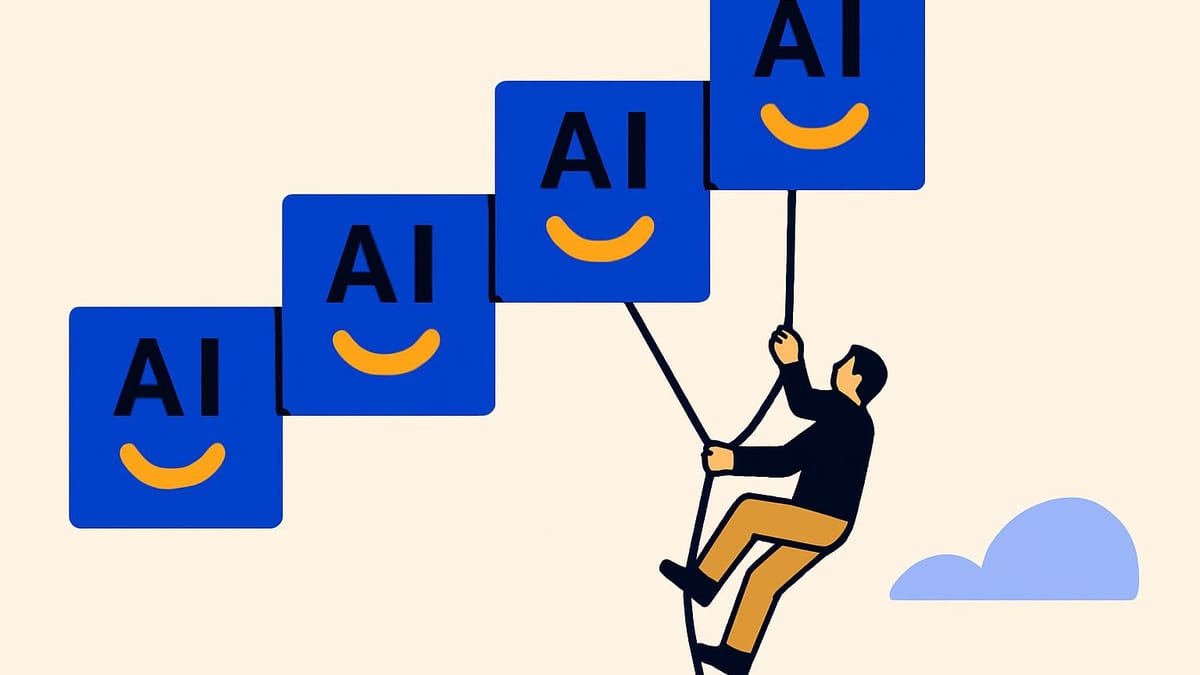
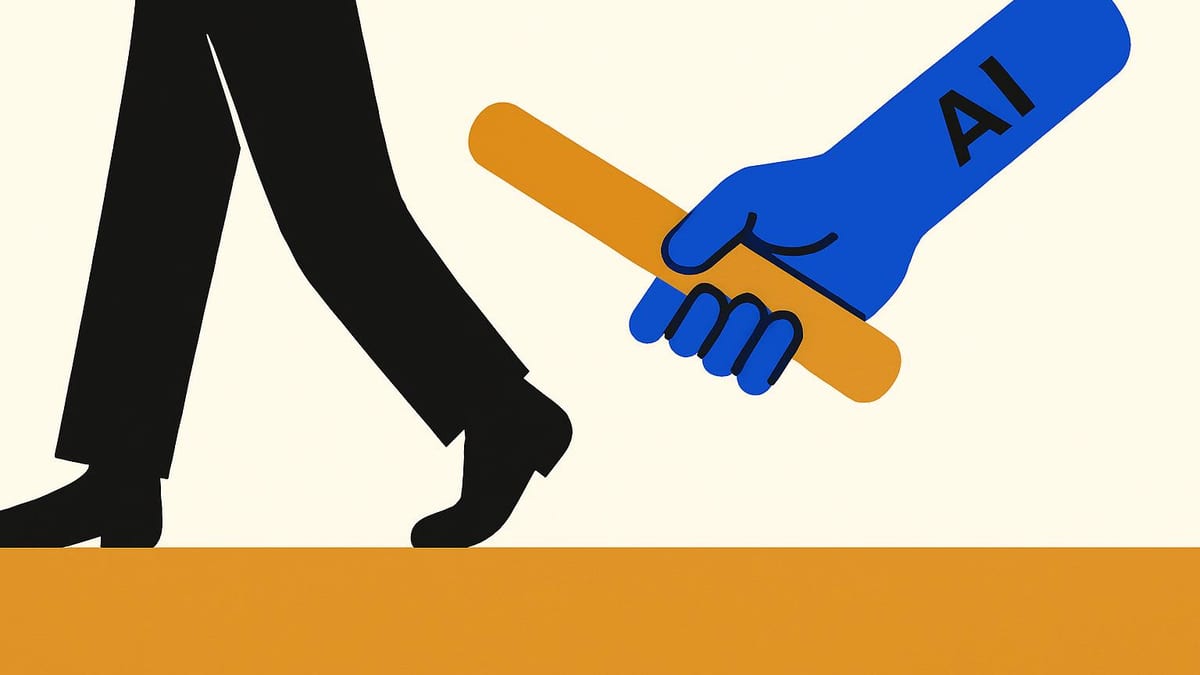
Weeks for the first climb, six to twelve months for the second, one to two years for the third, and a fourth that never ends. Four out of five organisations stop at the third, where journeys and services get rebuilt so an agent can call them.
 Article
Part 2 of 2. As long as adoption depends on one enthusiastic director and two volunteers, you have a pilot with good energy. The sequence that turns it into a way of working starts with a North Star in one sentence and ends with scale, last.
 Article
Part 1 of 2. A steering group spent its first eleven minutes on who would now own the AI program after the person who carried it for a year moved on. Four pilots were running, two with real customers, and nobody could say which would still be running in September.
 Article
The customer who calls you at nine in the morning is in her fifties, halfway through a life moment, nervous about money, using a channel she trusts more than your app. Behind her sits an agent reading your terms, your prices and your response times.
 Article
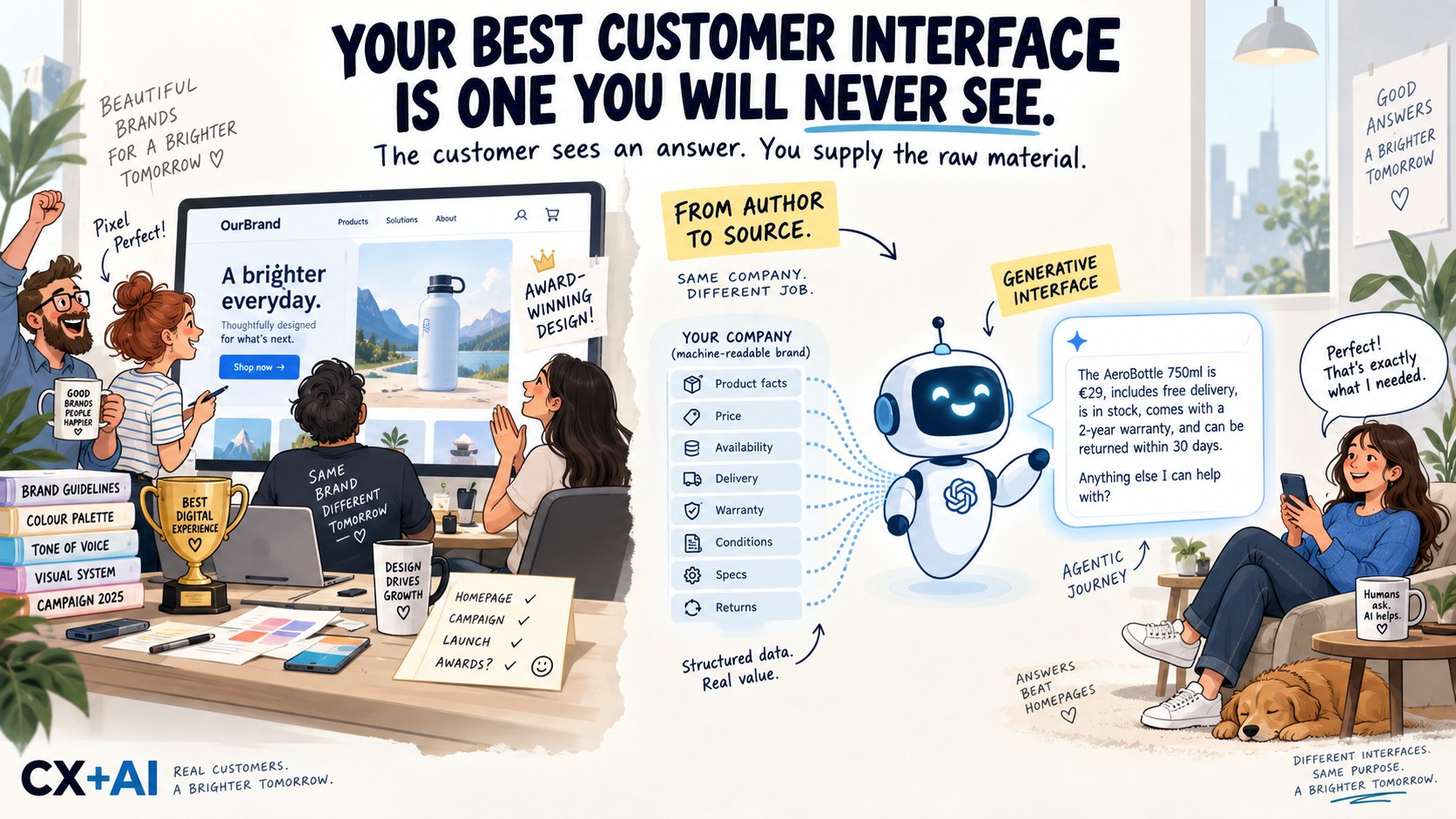
An agent reads your prices, conditions and product facts, weighs them against three competitors and presents one answer. This piece explains how you move from author to source, and what to own on Monday.
 Article
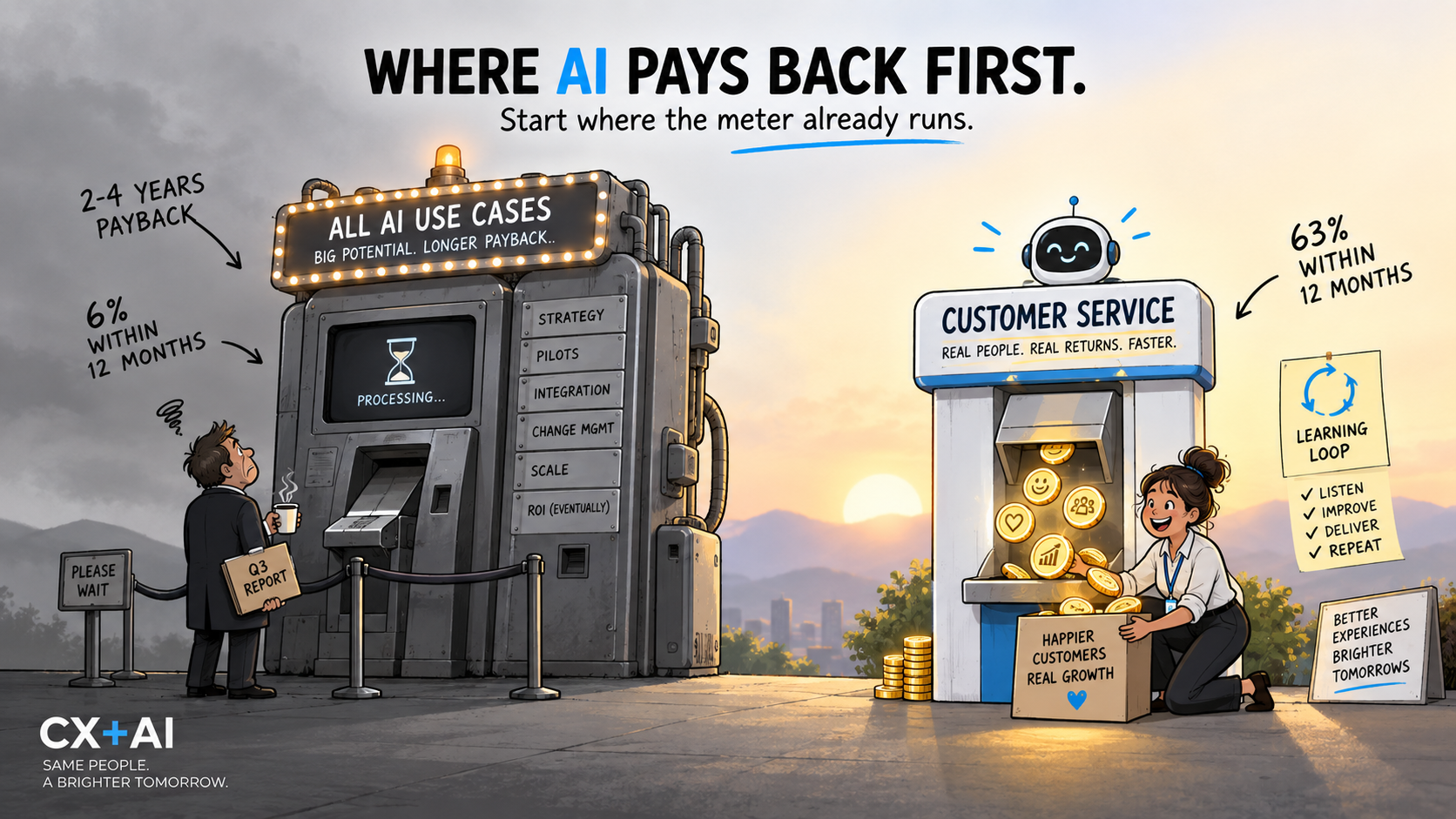
Deloitte asked more than 1,800 executives about their AI investments and found payback periods of two to four years. Customer service is the exception, with around 63 percent of those investments returning inside twelve months.
 Article
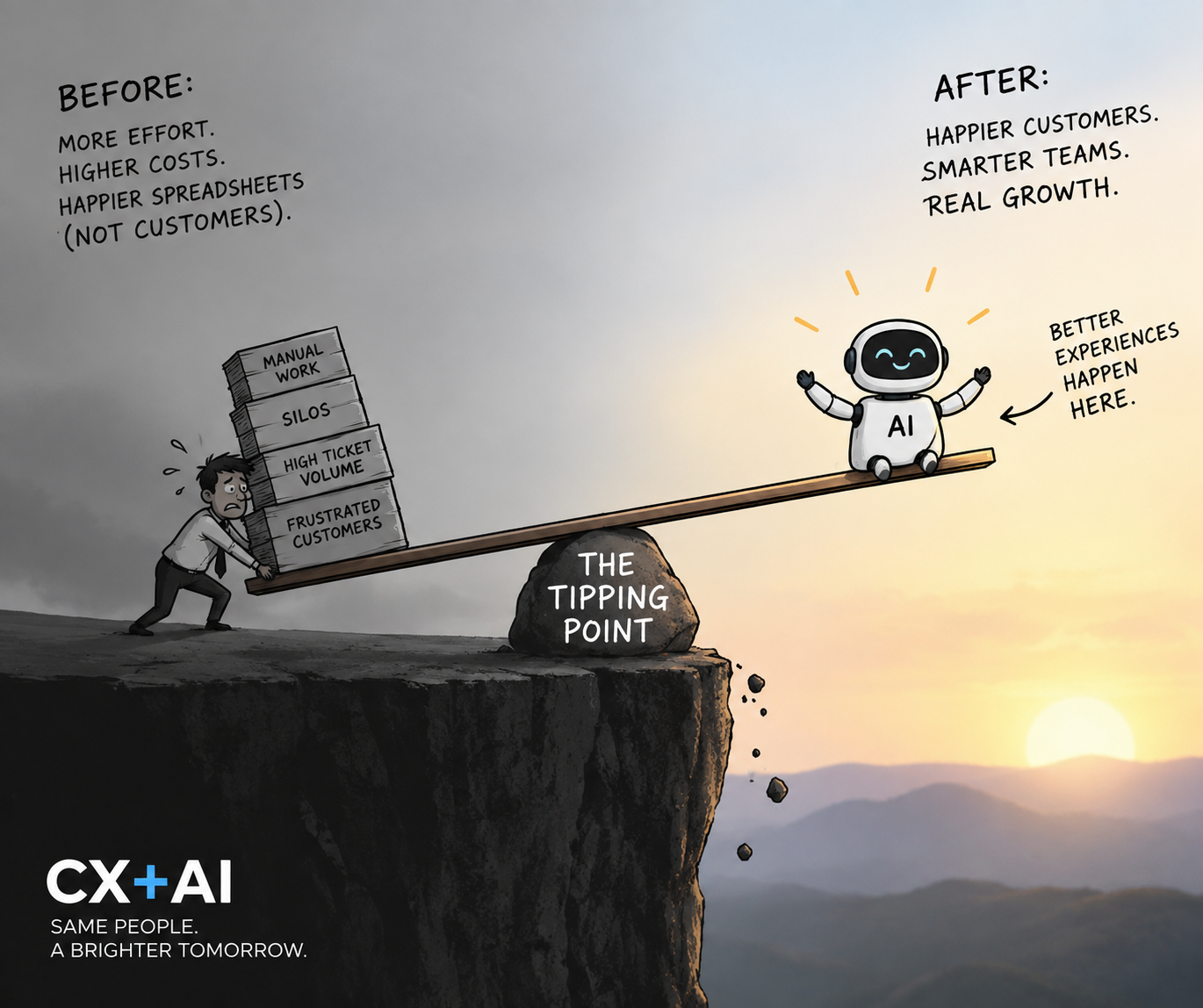
Chips at twenty-five thousand dollars apiece, data centres at millions per megawatt, and pilots that move nothing in the profit and loss account. Two of the three curves run ahead of you. Your maturity curve is the one you can work on this quarter.
Nothing found. Try another word.