
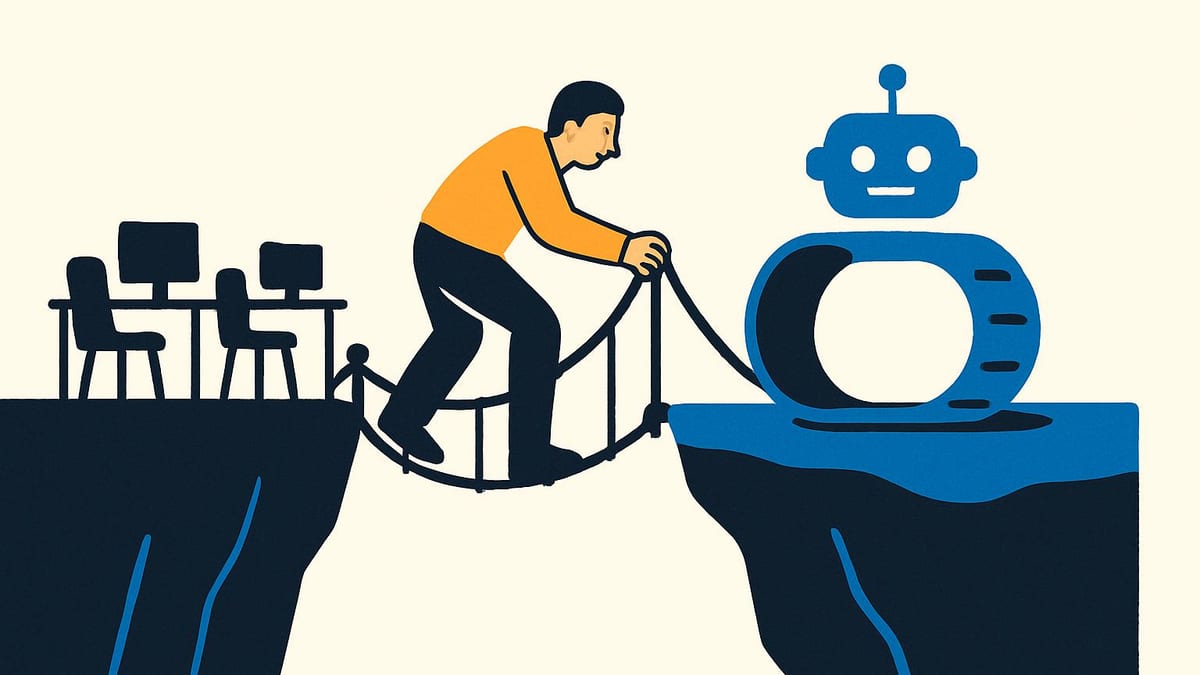
Two ways of working, side by side
Sinch surveyed 2,527 senior decision makers between January and February 2026 and found that 74 percent of enterprises with a live AI customer agent had rolled it back or shut it down after deployment. Among the organizations with the most mature governance, the rollback rate was even higher, at 81 percent. Those companies are not worse at AI. They look at their own output more closely and they act on what they see.
This is the second of two pieces on chapter 14. The first laid out the shift. This one is about the work: the way of working you inherited, the way of working that holds up now, and the exact point where one gives out and the other takes over.
The rollout and the climb
The old way treats AI as a rollout with a start date, a vendor and a go-live. You pick a use case, you buy a system, you announce it, you move on to the next one. That works for software that sits still. It falls apart for a system whose output changes with your data, your prompts and your customers.
The new way is a climb. Maturity runs over five levels, from ad hoc to self-improving, and you cannot buy a level or skip one. Itaú is doing it in public: the Brazilian bank reported in October 2026 that its conversational service ia.i had reached about 300,000 customers in a first phase, with the full customer base targeted for the end of this year. First a slice, then the next one.
Where it tips
It tips the moment the system speaks to a customer without a person in between. Up to that point AI is a productivity tool and a mistake costs you an hour. After that point every weak spot in your data, your policies and your escalation rules is visible to the person paying your bills.
That is the whole lesson behind the Sinch number. A multiplier on a sloppy refund policy gives you a sloppy refund policy at scale and at speed. AI will not transform your organization. It will expose it.
The organizations that pull an agent back are the ones that were measuring. That is a capability, and most of your competitors do not have it.
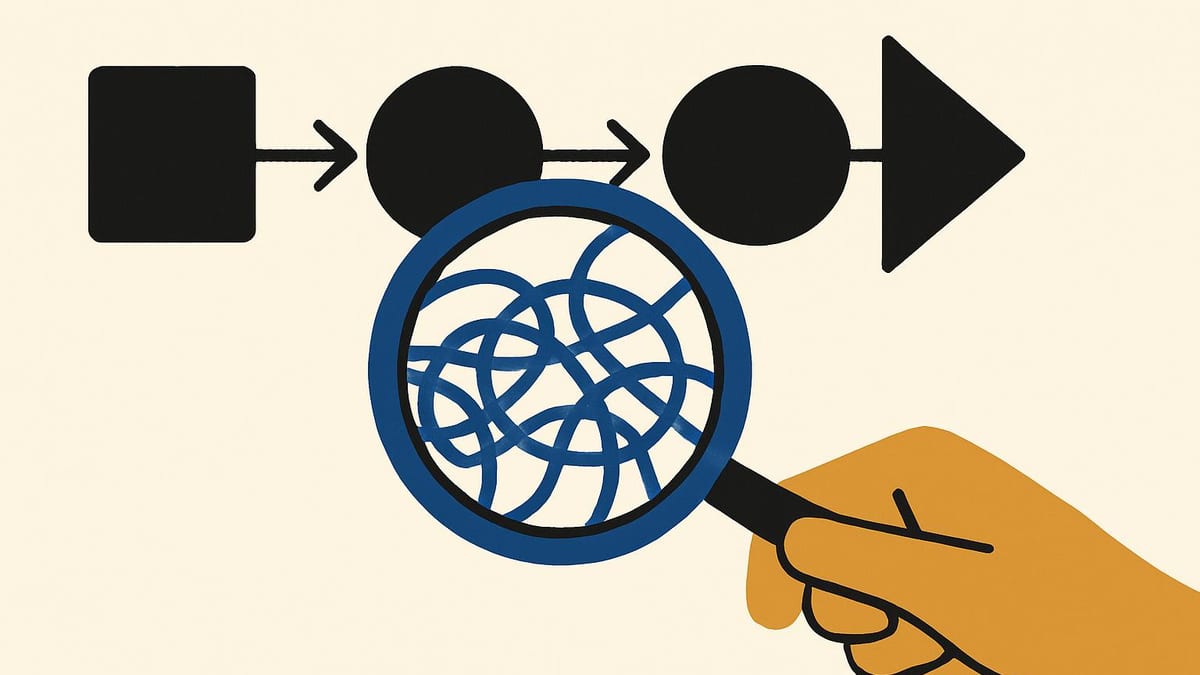
Who has to move
The layer that has to carry this is the layer AI squeezes hardest: team leads, operations managers, service supervisors. They own the handoffs, the exceptions and the quality bar. They also own the knowledge that never made it into any system.
Give that layer three things and they will move:
- decision rights on paper, so everyone knows which cases the agent closes and which it hands over;
- a weekly look at real transcripts, not a monthly dashboard;
- the authority to pull something back without asking permission upward.
What the customer notices
Your customer feels the difference within four messages. Either the conversation opens a door, which means it knows who you are and moves your case forward, or it hits a wall and starts asking for your order number for the third time.
Klarna learned this in public. CEO Sebastian Siemiatkowski said in February 2026 that his best people were rebuilding the AI support system from scratch, after the company had leaned too hard on cost cutting. Installing bought them this year's cost base. Integrating buys the slope, and slope compounds.
What you do on Monday
- Pick one live customer journey and read twenty real conversations end to end, with the team lead who owns it.
- Write down, in one page, which cases the AI closes on its own and which it hands to a person. Have it signed by someone with a budget.
- Set a quality threshold now and name the person allowed to pull the agent back when it drops below.
- Score your six building blocks honestly: strategy, data, way of working, governance, technology, culture and skills. Find your zero and fix that one first.
If you want to know which level you are actually on before you promise your board the next one, the CX+AI Maturity Check walks you through the five levels and the six building blocks in an afternoon. The full argument, including the ten shifts behind this chapter, is in the book.