
Five lenses, two readers
Your customer asks the same five things as last year. What has changed is who reads your answer first. Need and emotion, generation, psychology, channel and trust, life moments: those five lenses still hold. Behind every one of them a second reader has taken a seat, and that reader is a machine working on the customer's behalf.
This is the second of two pieces on reading the customer. The first laid out what the five lenses show you. This one is about the work: how yesterday's way of reading differs from today's, and the exact point where it tips.
The way we worked yesterday
A persona on the wall, a journey map underneath, one channel per step. That setup did real work for fifteen years. You picked a tone per segment, wrote the FAQ in plain language, measured satisfaction per channel and fixed the step with the worst score.
It rested on three assumptions:
- the customer reads your page with his own eyes
- channel preference follows age closely enough to plan around
- the words on the screen reach the person who decides
Those assumptions held while a human being was the only one doing the reading.
The way it works now
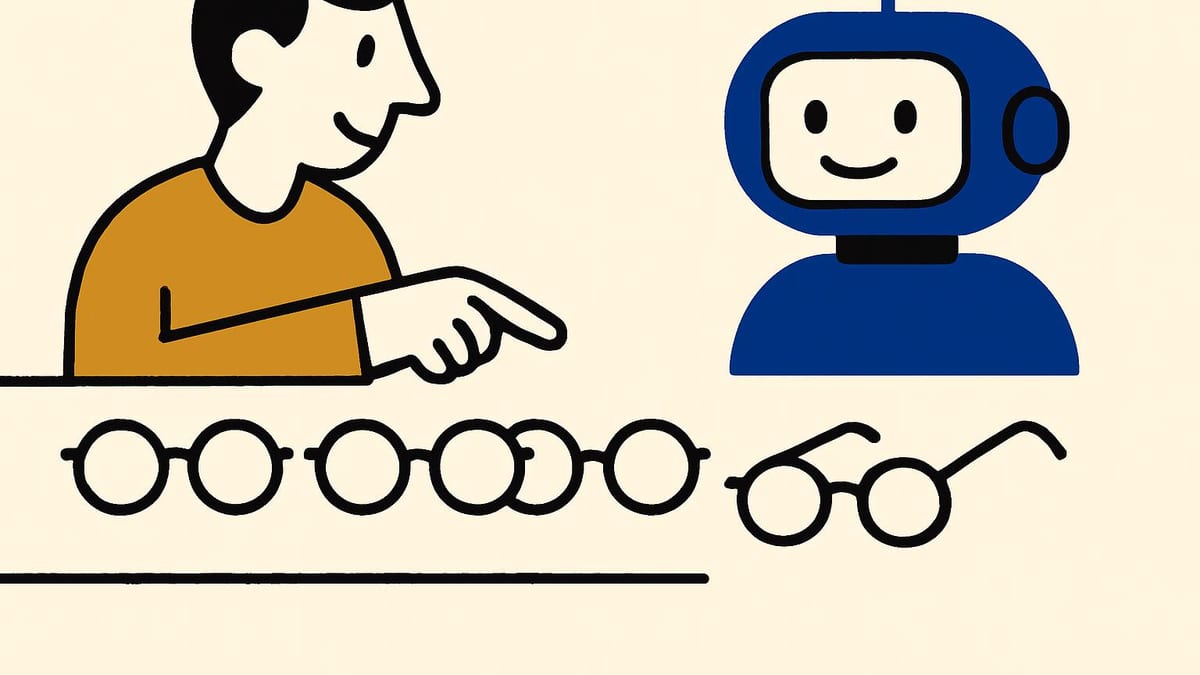
Every lens is now read twice: once by a person, once by an agent. The person wants to feel understood. The agent wants structure it can parse, compare and act on. Both are looking at the same page, and they need different things from it.
The generation lens shows how fast this happened. Roughly three quarters of Gen Z uses generative AI actively. Among millennials, four in five used AI in the past year, and three quarters of them say it improves their efficiency.
So the question behind each lens gets a second half. For the channel and trust lens: which channel does this customer trust, and which agent does he trust to speak for him there.

Where it tips
Passive adoption runs roughly three times ahead of active. That ratio is the tipping point. For every customer who deliberately opens a chat tool, about three are already being served by summaries, suggestions and automatic answers inside software they were using anyway.
Those three never told you. They never will.
The early boomers make the same point from the other side: among non-users in that group, one third says they do not understand the tools well enough. They are still being read to by an agent inside their banking app or their search results.
Design for the reader who was never asked whether he wanted one.
Rewriting one journey step
Pick the step where most of your customers get stuck, and read it twice. One hour, two passes, one page of notes. That is the whole exercise.
The human pass
Read the step out loud. Mark the sentence where the emotion turns: relief, irritation, doubt. Write down the life moment behind the visit, because a mortgage question during a divorce is a different question.
The agent pass
Open the same step and ask what a machine can lift out of it:
- the price, the term and the conditions as separate facts rather than running text
- one clear action per screen, with a name a machine can repeat back
- the handover point where a person takes over, stated on the page
What you do on Monday
- Take one journey step and run both passes on it before lunch.
- Ask your five largest customers which tool they used before they reached you, and write down the answer word for word.
- Add one line to every persona: what does this customer let an agent decide for him.
- Name the handover point in your top three steps, so people and agents both know where the human part starts.
- Book a second hour two weeks later and read the same step again, now with the changes in it.
Reading twice turns one journey map into two. The Agentic Journey Map in the CX+AI materials gives you a working template for the second pass, with the questions per lens already in place. It saves you the afternoon of building the format yourself. View the materials