

The level you are actually on
Every board meeting about AI arrives at the same question: are we ahead of our competitors or behind them? It is a fair question and it deserves a direct answer. The answer is that you are almost certainly a level lower than you think, and that the gap between your self-assessment and your actual position is the most useful number you can put on the table.
EXL asked 322 C-suite leaders where they stood. Seventy-six percent believed they were ahead of the competition. Roughly 10 percent actually were. IBM and Ecosystm found the same pattern in Asia-Pacific: 85 percent call themselves data-driven or AI-first, 11 percent can demonstrate it.
What a rollback tells you
Pulling an AI agent out of live customer contact is a measurement, and it is worth reading as one. Research from communications platform Sinch, published on 13 May 2026, found that 74 percent of enterprises with a live AI customer communications agent had rolled it back or shut it down after deployment, and the rate rose to 81 percent among organisations with the most mature AI governance programmes.
That higher number among the better-governed teams is the interesting one. They were not worse. They were watching, and watching is a level 3 capability. Organisations at level 1 and 2 rarely roll anything back, because nobody is measuring what the agent does to the customer after week two.
A programme that has never been pulled back is not safe. It is unmeasured.
The pilot met its case and nothing else changed
A successful pilot proves the pilot. FTI Consulting surveyed 200 fund and operating leaders for its 2026 Private Equity AI Radar and found that 95 percent of funds report AI initiatives meeting or exceeding their original business case, while only 7 percent of portfolio companies have reached enterprise-scale deployment. IDC puts it from the other side: roughly 88 percent of proofs of concept never reach broad rollout.
Both facts sit together comfortably. The business case was written for a sandbox with twelve use cases and an engineer on standby. Scale was never part of what you tested.
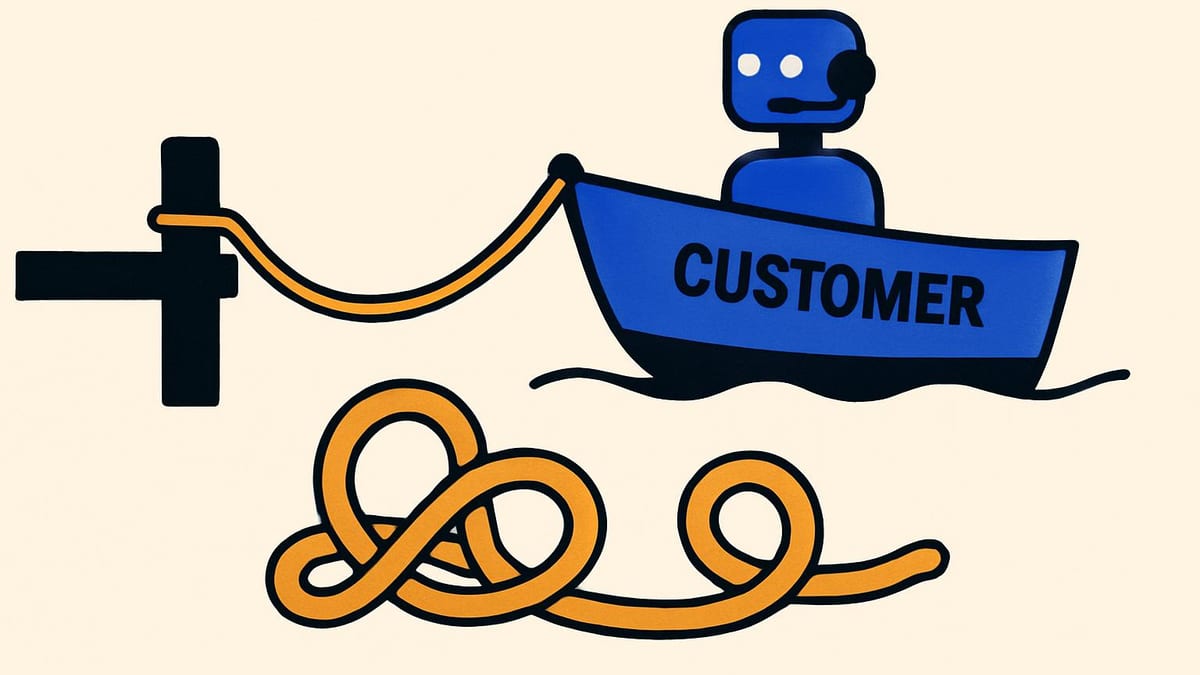
What the customer feels at level 2
The customer never sees your maturity model, and feels it inside four messages. High CX maturity is associated with up to 30 points of additional NPS, roughly double the loyalty, and up to a third lower service costs. Those gains come from the ladder itself, not from the tool you bought last quarter.
At level 2 the agent answers quickly and then hands over to a person who asks everything again. At level 4 the handover carries the context, the promise made, and the authority to keep it.
Who has to move
The operating model is where maturity is won, and that work belongs to the people who own the process, not to the AI team. EXL found that 44 percent of leaders had redesigned their operating model, against 23 percent of laggards, and that leaders are roughly 2.5 times more likely to have data available where decisions are actually made.
The layer that blocks this is the middle. Team leads and process owners are asked to drive adoption of something that reshapes their own span of control. Give them the new span first, in writing, and the adoption follows.

What you do on Monday
- Score three live use cases against the five levels, with evidence per level, and let someone outside the team mark them.
- Pick one case of a customer journey and read back the last twenty conversations the agent had. Count the handovers.
- Name one process owner per use case, with a throughput number and the authority to change the surrounding process.
- Book the operating model redesign before the next rollout, and put the hours released into a budget line so you can see them.
If you want the scoring to be comparable across teams instead of a debate about who feels furthest along, the CX+AI Maturity Check gives you the five levels with the evidence each one requires. It takes an afternoon and it usually produces a lower score than expected, which is the point. Bekijk de materialen