
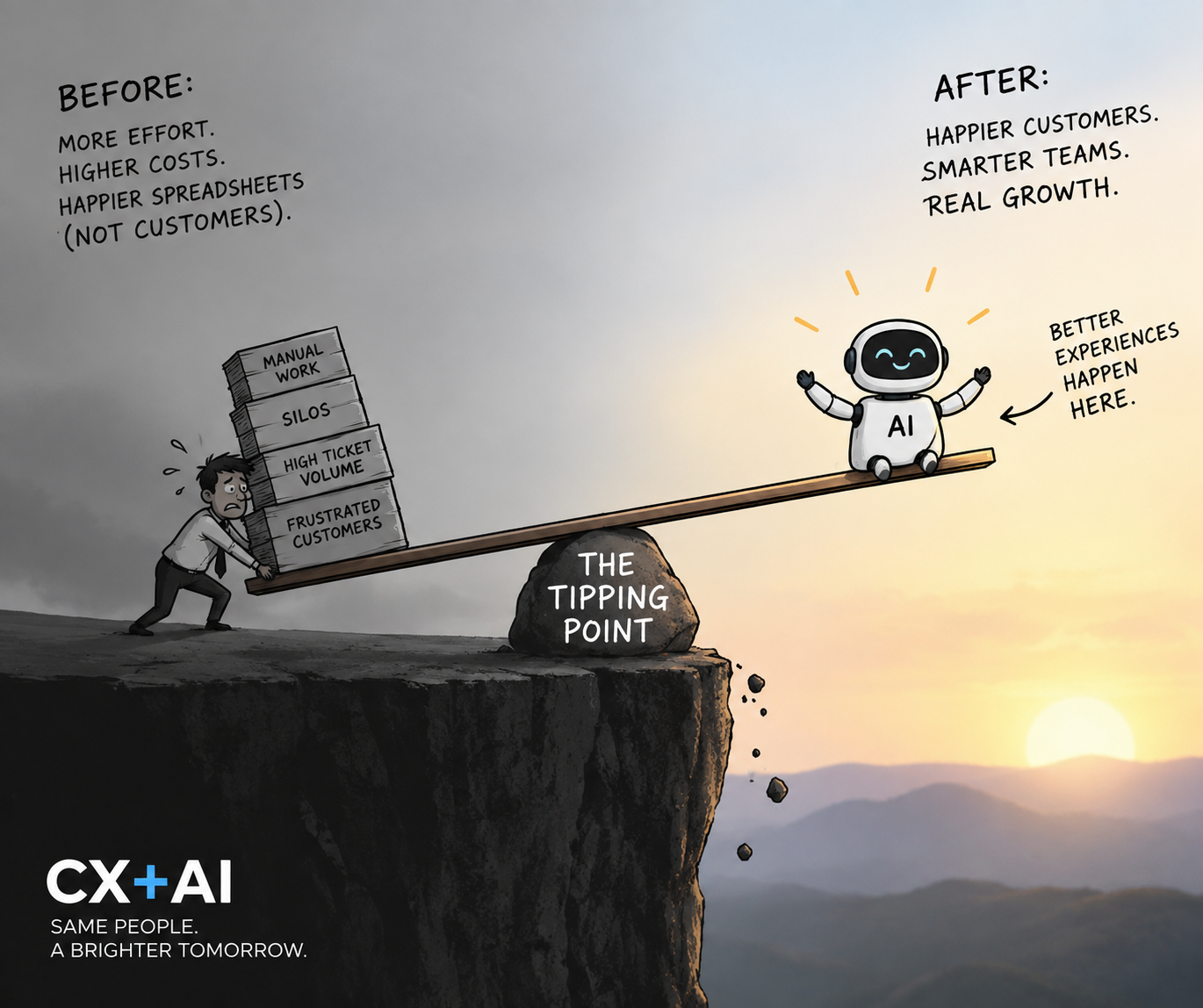
DE TIPPING POINT VAN CX+AI
Intro
AI is an evolution, and it is being budgeted for as a revolution. That gap is where most programmes get stuck. The technology moves in steps, the spending moves in leaps, and the organisation that has to absorb it moves slowest of all.
I see the same pattern in boardroom after boardroom. Ambition is high, the budget is signed, the pilots run. A year later nobody can point to a line in the profit and loss account that moved. The plan rests on one assumption: that buying capability is the same as having it.
An evolution with a revolution's budget
The market is paying revolution prices for progress that arrives in increments. Chips cost more than twenty-five thousand dollars apiece. Data centres run fifteen to twenty million dollars per megawatt. Inference, the part where a model actually answers a question, takes eighty to ninety percent of the compute, so the bill keeps arriving long after the model is built.
The Bank for International Settlements compared this build-out, roughly a trillion dollars, with the railway bubble and the dotcom crash. Both of those left behind infrastructure the world still uses. Both also left behind investors who paid for a timeline that never held.
In January 2025, DeepSeek wiped almost six hundred billion dollars off Nvidia's value in a single day. One release, one repricing of what compute is worth.
Infrastructure gets built either way. The question is who is still standing when it starts paying.
What the spending has bought so far
Gartner reports that organisations spent an average of 1.9 million dollars on generative AI in 2024, and fewer than thirty percent of AI leaders say their CEO is satisfied with the return. MIT found that roughly ninety-five percent of pilots showed no measurable effect on profit.
Read those two numbers together and a picture forms. The money is being spent. The capability is real. The organisation around it has not changed shape, so the capability lands on processes that were already unclear, on data that was already fragmented, on teams that already had no owner for the customer journey end to end.
What usually sits under a stalled pilot:
- a use case chosen because it was easy to demo, not because a customer was waiting for it
- data that three departments each hold a version of
- no one with the authority to change the process the model is supposed to improve
- a success metric that measures activity instead of outcome
Three curves, one of them yours
Technology, the market and your own maturity all move at once, and you control exactly one of them. The technology curve is set by labs and chip makers. The market curve is set by what your customers and competitors start expecting. Your maturity curve is set by you, and it is the only one you can actually work on this quarter.
Maturity runs from level one to level five across the six blocks of the ecosystem. You can buy tools for any of those blocks. You cannot buy the level.
Why the gap keeps widening
The first two curves do not wait. Relevance is not something you catch up to later by spending more. Climbing is the whole method.
AI is a multiplier
AI multiplies what is already there, so it exposes the organisation rather than transforming it. Strong process, clear data, clear ownership: the multiplier pays. Weak foundations get amplified just as faithfully.
A multiplier on zero gives zero. That is the cheapest lesson in this chapter, and the one most programmes learn the expensive way.
Buy the tool and you own the tool. Climb the ladder and you own the result.
What you do on Monday
- Pick one customer journey and write down, on one page, who owns it end to end.
- Score your six ecosystem blocks from one to five, honestly, with evidence for each score.
- Take your lowest-scoring block and fund one improvement there before funding another pilot.
- Attach every running pilot to a number in the profit and loss account, and name the person who watches it.
- Book a quarterly review of your maturity scores, so the climb has a rhythm.