

A steering group I sat in spent its first eleven minutes on who would now own the AI program. The person who had carried it for a year had moved into another role two weeks earlier. Four pilots were running, two of them with real customers on the other end. Nobody in that room could say which of the four would still be running in September. They could all say who used to make sure they were.
That moment is the whole test. A transformation has landed when the new way of working survives the departure of the people who pushed it. Everything before that is a program with a fan club. This is part one of two on this chapter: here I lay out what was actually going on in that room, and part two covers the sequence you use to fix it.
The eleven minutes were the finding
Succession was the topic because adoption had never happened. Four pilots, each with an owner, each with a slide. When you asked what changed in a team's week because of them, the answer came back as a number of conversations handled, never as a job that was now done differently.
A pilot that depends on one person's attention is a favour, not a way of working. The favour ends when the person does.
A transformation is finished when the new way survives the people who started it.
What the board thinks it is buying
Directors are measured on quarters, and a quarter is exactly long enough to buy a tool and exactly too short to change how anyone works. So the budget goes to the thing that can be shown: a licence, a pilot, a proof of concept with a satisfied vendor.
The chapter names five points where AI breaks classic change management, and every one of them was in that room:
- The pace. The technology moves faster than the change program written to introduce it.
- The rational self-interest of your people. Someone whose expertise is the reason they get asked things has a real stake in the old way.
- The shadow adoption. Your people started months ago, on their own accounts, outside your sight.
- The invisible burning platform. Nothing is on fire this quarter, so the urgency has to be argued rather than felt.
- The missing target group. There is no department to roll this out to. It touches everyone, at different speeds.
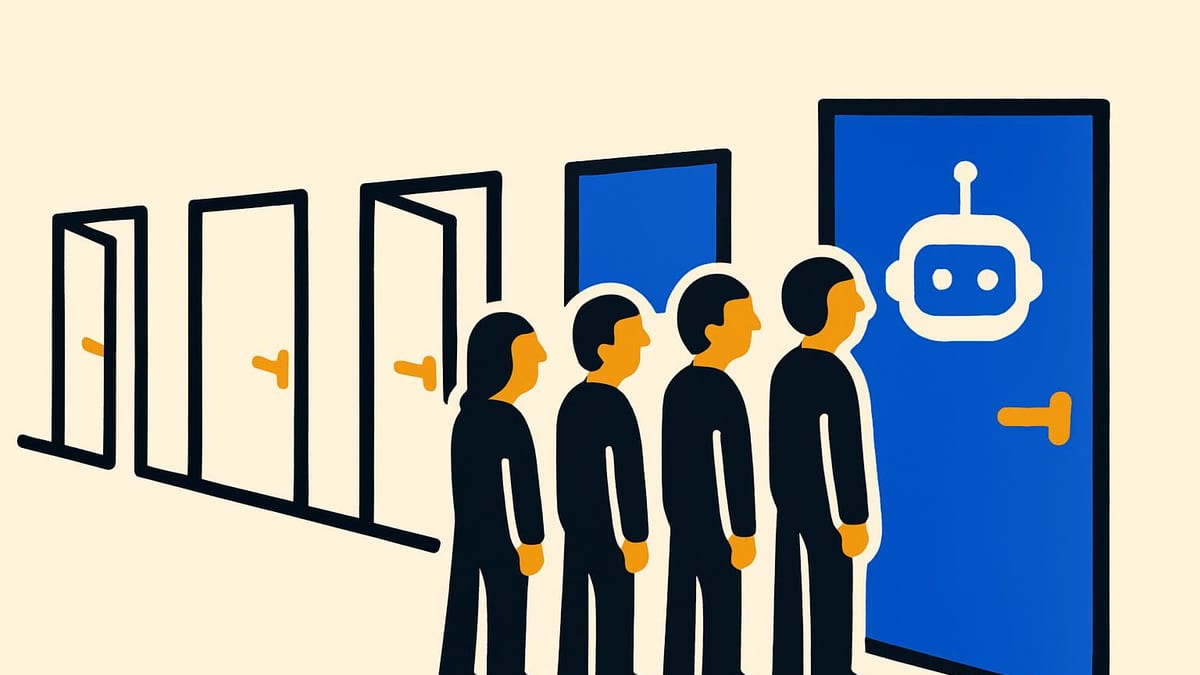
The layer you are asking to lead its own threat
The middle of your organization is where AI lands hardest and where you are asking for the adoption to be led. Team leads, group managers, the people whose value is coordination, oversight and knowing how it works here. That is precisely the work a model does cheaply.
Then you hand them the adoption plan. The frozen middle is a rational middle. They read the slide and they can see what happens to their job when it works.
In that steering group, three of the four pilot owners sat in that layer. All four pilots stalled at the same point: the hand-off into daily work.
What it costs you per quarter
Every restarted pilot is paid for twice, once in licence and once in attention. The attention is the expensive one, because your best people spend it, and because the second attempt lands in an organization that has already watched the first one fade.
Shadow adoption keeps running the whole time. People go on using the tools they found themselves, with your customer data, outside any guardrail you wrote. The adoption you are trying to create already exists. It is just not yours yet.
The question is not whether your people use AI. It is whether you can see it.
What you do on Monday
- Ask each pilot owner one question: what does a team do differently this week because of your pilot?
- List the AI tools your people already use on their own accounts, without consequences attached to the answer.
- Pick one pilot and remove its champion for four weeks. Watch what holds.
- Sit down with three people from your middle layer and ask what their job looks like when this works.
The sequence for making adoption stick, from North Star to scaling, sits in chapter 15 of CX+AI. Part two of this series walks through it. If you want to see where your own organization stands before then, the CX+AI Maturity Check gives you the picture in an afternoon. Take a look at the materials.