
A director slid a quote across the table and asked me whether this was normal. A platform, a pilot, a data foundation, a partner for a year. The total was in the range of a new production line. He had twelve people, no data team, and a customer base he knew by first name.
We put the quote face down and drew three lines on a sheet of paper. Within ten minutes he could see where his money was going, and it had almost nothing to do with his customers.
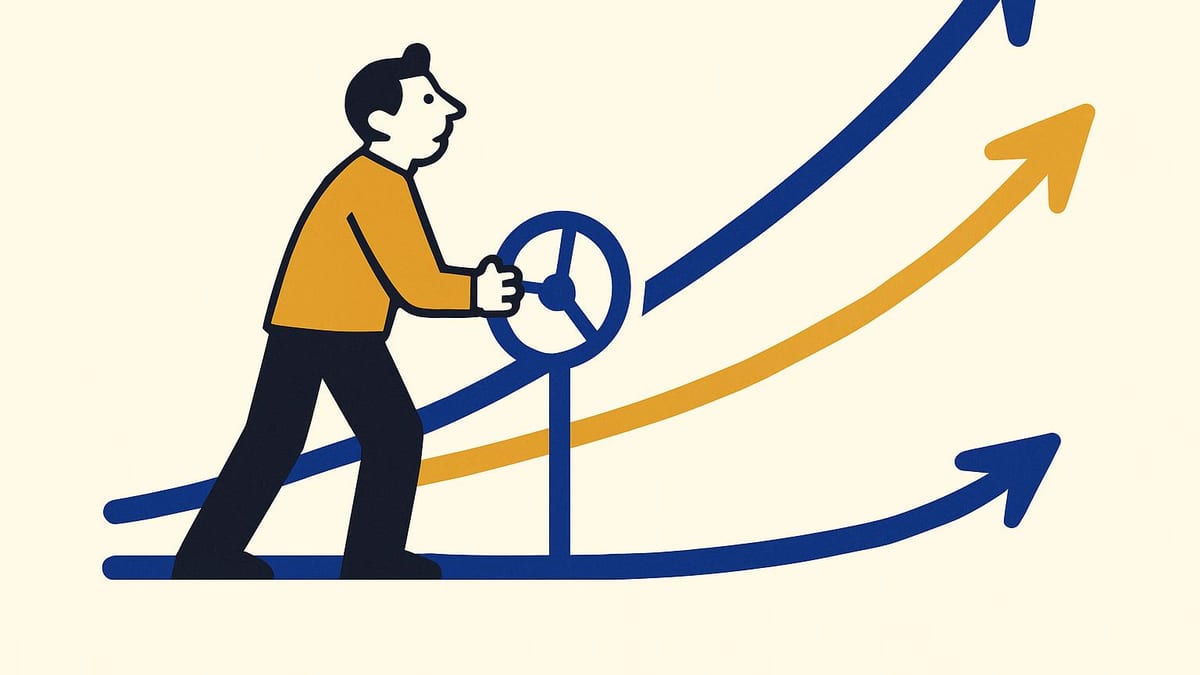
Three curves, one of them is yours
Technology, the market and your own maturity all move at the same time, and only the third one belongs to you. The technology curve runs on other people's research budgets. The market curve runs on sentiment: in January 2025, DeepSeek wiped nearly six hundred billion dollars off the value of Nvidia in a single day. Nothing in that company's products changed that morning.
Your own curve is the one you set the pace on. It moves when your people handle a customer question better this month than last month.
The two curves you read about in the news are the two you cannot steer.
The bill underneath the noise
Most of the money in AI is being spent on capacity, and capacity gets cheaper while usage grows. The numbers are public and worth knowing before you sign anything:
- Chips at more than twenty-five thousand dollars apiece.
- Data centres at fifteen to twenty million dollars per megawatt.
- Inference, the everyday running of models, at eighty to ninety percent of total compute.
The Bank for International Settlements compared this buildout, roughly a trillion dollars, to the railway bubble and the dotcom crash. Railways got built. Plenty of the companies laying the track did not survive to run trains on it.
What the spending brought back
Gartner found that organisations put an average of 1.9 million dollars into generative AI in 2024, and fewer than 30 percent of AI leaders said their CEO was satisfied. MIT looked at the pilots and found roughly 95 percent with no measurable effect on profit.
The pattern under those numbers
Money went to capability, not to a customer problem. A model was bought, a use case was found afterwards, a demo impressed the board, and the work in the customer journey stayed exactly as it was. You can spend a year that way and have a working chatbot nobody asked for.
The director at my table had the advantage here. He had no data team to keep busy and no board to impress. He had a call queue that was too long on Mondays.
Budget for evolution, not for a launch
AI is an evolution that most companies are budgeting for as if it were a revolution. A revolution budget is one big number, one big vendor and one big moment. An evolution budget is a series of small amounts tied to one customer question each, with a date when you check whether it worked.
That director now spends a fraction of the quote per quarter. First target: the Monday queue. He knows what an hour of waiting costs him, so he knows what the improvement is worth.
Start where a customer is already annoyed. They will tell you whether it worked.
What you do on Monday
- Pick one customer moment that costs you time or goodwill every week, and write down what it costs.
- Set a budget for that one moment for one quarter, in an amount you can lose without pain.
- Name one person who owns the outcome, with a date and a number attached.
- Ask any vendor what happens to your costs when usage doubles, and get the answer in writing.
- Book a review at the end of the quarter where you either scale it, change it, or stop it.
The quote on that table was an answer to a question nobody had asked yet. The CX+AI Business Case helps you write the question first: which customer moment, what it costs you now, and what a quarter of work has to deliver before you spend more. Bekijk de materialen