
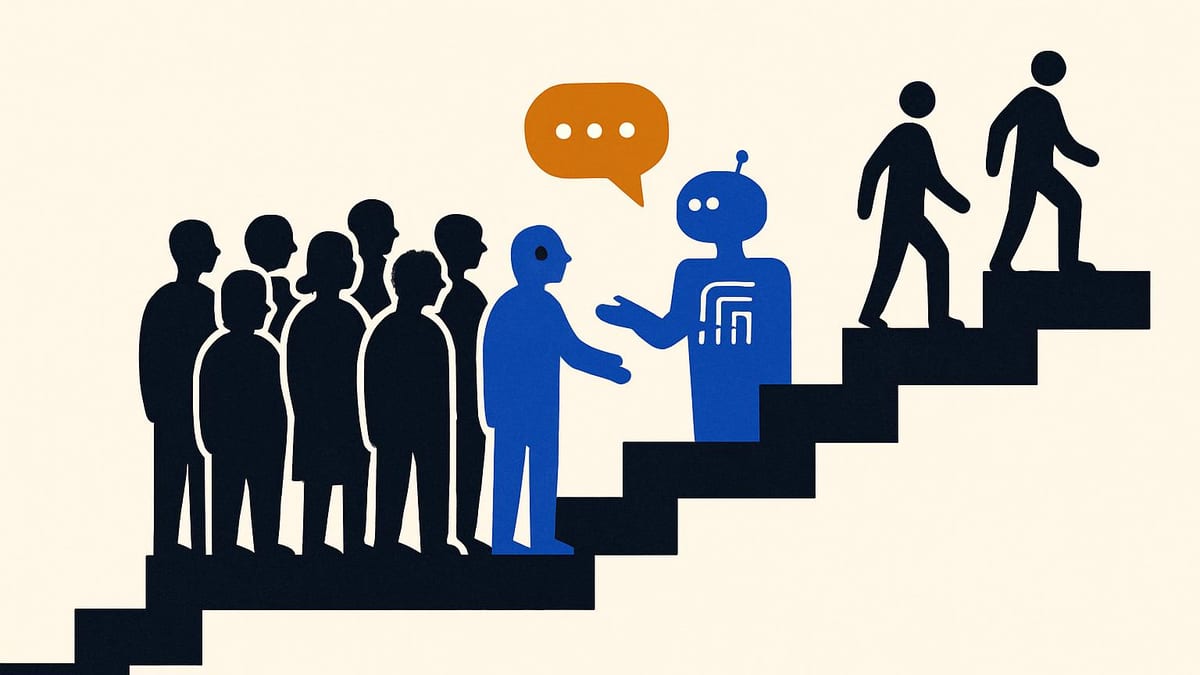
Most boards believe the hard part of an AI transformation is getting started. Deciding takes weeks. You pick a platform, name an owner, free up budget, and you can do all of it between two quarterly reviews. The roadmap in CX+AI puts that first climb at weeks, and the second one, connecting your data and setting up governance, at six to twelve months. Both fit inside a planning horizon a board recognises.
The third climb is where the arithmetic turns against you. Redesigning your processes and making your organisation callable by machines takes one to two years, and four out of five companies stop there. They stop because the climb outlives the attention of the people who launched it.
The pilot was never the test
A chatbot in production proves that your vendor works. It says nothing about whether your organisation has changed. I have sat in steering committees where a live assistant was celebrated while the process behind it stayed exactly as it had been for a decade, with the same handovers, the same approvals, the same four departments touching one request.
Each of the four climbs in the roadmap carries three things: actions, owners and an exit test. The exit test is the part that gets quietly dropped. Without it you keep reporting progress on a climb you never finished.
Progress you cannot test is progress you are claiming.
Four climbs, five levels
The roadmap has five levels, and the four climbs between them each run on their own clock.
- Decide: weeks.
- Connect and govern: six to twelve months.
- Redesign and become callable: one to two years.
- Let the system learn: it never ends.
Look at those durations against your own reporting rhythm. Three of the four climbs run longer than the cycle you are measured on, and the longest one sits in the middle, far from both the launch applause and the eventual payback. That is the structural reason the third climb claims so many companies, and it is a reason you can plan around once you name it out loud.

The measure that fits a quarter
Absorption time is the one number that tells a board how fast the company actually is. It runs from the moment a capability becomes available to the moment it runs safely in production. Most organisations measure that in budget cycles. The roadmap sets the target in weeks.
What makes it useful is that absorption time measures you, not the model. Procurement owns a slice of it. So do legal, risk, data and release management. Put the number on the board agenda every month and the bottlenecks name themselves within two reporting rounds, because each owner can see the piece of the clock they hold.
The kit that keeps it standing
Mindset and skillset stay in the company through seven ordinary instruments, all of which already exist in your HR function. The anchoring kit covers an academy, certification, onboarding, roles and career paths, measuring, rewarding, and perspective.
None of these are exotic. They are the normal machinery of a company, pointed at a new capability. Someone joining you in nine months should meet your AI way of working in their first week, see it in their job description, and find it in the criteria for their next step up. That is what carries you through a climb of one to two years when the original sponsor has moved on.
What you do on Monday
- Ask your team which of the four climbs you are on, and ask for the exit test that proves it.
- Measure absorption time on one capability you already have, from available to live.
- Put an owner on each stage of that clock, by name.
- Add one AI-related criterion to the next three job profiles you open.
- Set a review date eighteen months out and name who owns the third climb until then.
The roadmap, with the actions, owners and exit tests for each of the four climbs, is worked out in full in chapter 17 of CX+AI. The AI Transformation Roadmap gives you the same structure as a working document you can put in front of your board this quarter. Bekijk de materialen