
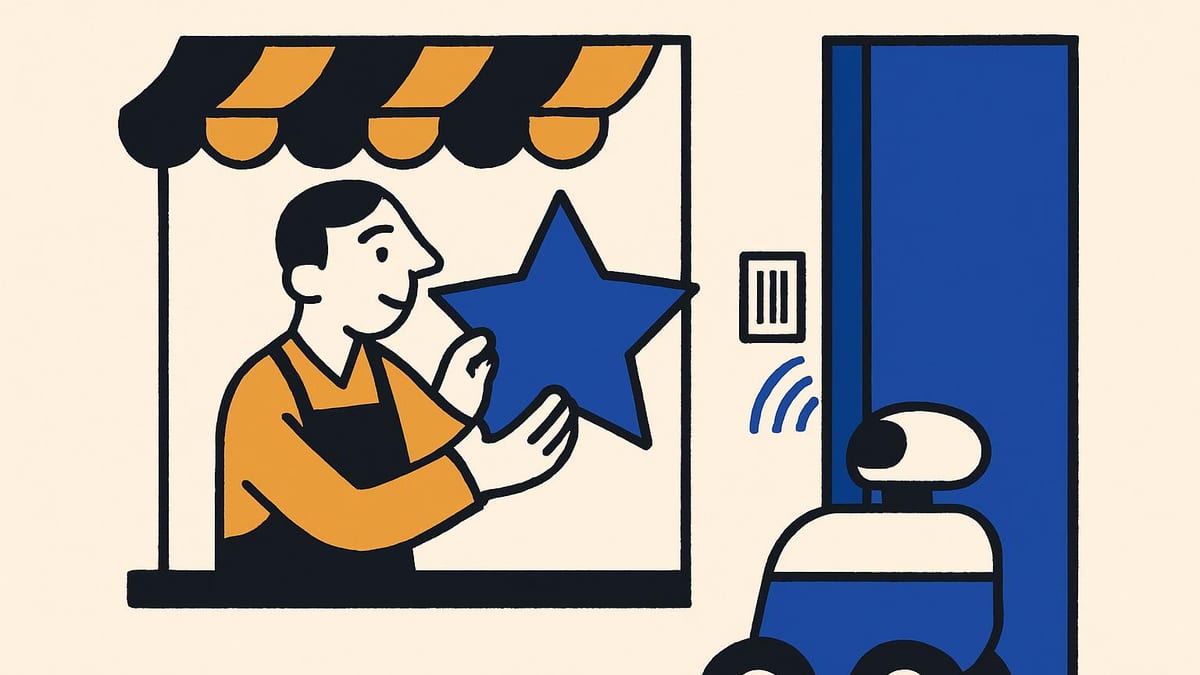
The agent is reading your catalogue
Your next customer may never open your website. They will ask an assistant a question, get three options back, and pick one of them. What the assistant knows about you comes from whatever it could read in a machine-readable form, and that is usually a feed someone exported years ago and forgot.
This is the part of AI that has nothing to do with buying a tool. It is about who in your company owns the facts about your products, and whether those facts are true, fresh and readable at three in the morning without a human present.
What Walmart found inside ChatGPT
The biggest retailer in the world ran this experiment in public and the result was uncomfortable. Walmart made about 200,000 products available in ChatGPT and found that conversion was three times lower for products bought directly in ChatGPT than for products that sent shoppers to Walmart's own site to check out. Walmart's own data also showed roughly twice as many new customers arriving through ChatGPT, value you miss entirely by counting in-chat checkouts.
The platform side moved just as fast. OpenAI launched Instant Checkout on 29 September 2025 with Etsy and a promise of over a million Shopify merchants, and by March 2026 CNBC reported it was ending the feature in favour of retailer apps inside the chatbot. Forrester counted roughly thirty Shopify merchants actually live by early 2026.
From author to source
The checkout button moved, the reading did not. A Semrush survey of more than 1,000 US consumers found 22 percent had bought something inside an AI tool, while about half had bought after using AI during their research. That half is where you are won or skipped, and you are not in the room for it.
You write for a human. The agent reads the same page first, decides whether you belong on the shortlist, and only then shows a human anything at all.
The human interface rewarded the appearance of quality. The agent reads the fact of it.

Nobody owns the feed
Most companies have a brand team of thirty and a structured data team of nobody. In a smaller company the numbers differ and the gap is identical: three people guard the tone of voice, zero people guard the return window as a data field.
John Harmon of Coresight Research told the US Chamber of Commerce that the most important move for small merchants is making their product pages available to AI chatbots and browsers, and that not sharing your product information puts you at a big disadvantage. That is a job with an owner, a deadline and a budget, or it is a job that stays undone.
Who has to move
- The person who owns pricing, because stale prices get your listing dropped.
- The person who writes copy, who now writes specifications a machine can lift out.
- You, because this competes with the website redesign and usually loses.
Controlled, declarative, open
You get to choose how much you hand over, and the choice is a business decision. Keep the experience fully controlled and you stay in charge of every pixel while fewer agents can use you. Go declarative and you publish the facts and the rules, and let the interface assemble itself. Go open and the agent composes the whole thing.
The reward for being readable has turned. Adobe Digital Insights reported in April 2026 that AI-referred traffic converted 42 percent better than non-AI traffic in March 2026, a complete reversal from converting 38 percent worse a year earlier, based on more than a trillion visits across over 130 North American retailers.

What you do on Monday
- Ask the three assistants your customers use what your best product costs, how long delivery takes and what the return window is. Write down every answer that is wrong.
- Give one named person ownership of product data, with price, availability, identifiers and policies as their weekly responsibility.
- Publish your return and shipping terms as structured fields on the product page itself, not as a link to a policy page.
- Check your storefront settings: Shopify switched Agentic Storefronts on by default for eligible merchants on 24 March 2026, making products from 5.6 million stores discoverable across ChatGPT, Copilot, Google AI Mode and Gemini.
- Measure AI-referred sessions and new customers, the way Walmart did, instead of in-chat checkouts alone.
The test above gives you a list of wrong answers by Monday afternoon. The Agentic Journey Map turns that list into the sequence an agent actually walks through on your behalf, step by step, with the facts it needs at each one. The book CX+AI covers the three disciplines behind it: a machine-readable brand, the agentic journey and the generative interface. Bekijk de materialen