

Your version of the climb
The second question in every boardroom is the same: does this apply to us? The first question is about the technology. The second one is about the company, and it usually comes from the person who has sat at the table longest. We are not retail. Our customers call, they do not chat. Our market is regulated. Our people are not going to touch this.
My answer is short. The route up is the same for everyone, and the terrain underneath it differs per company. Four things decide what your terrain looks like, and all four are things you can name before lunch.
Where your zero sits
Your sector decides at what height you start the climb. A company whose customer contact has been digital for a decade already has the data, the logs and the handovers in one place. A company that still prints work orders starts lower on the same mountain. Both climb the same route. One simply has a longer first stretch.
So measure your zero before you set a target:
- the customer processes that already run end to end in a system
- the share of contact that leaves a written trace
- the data you can reach without asking a supplier for an export
- the decisions in your service process that are written down somewhere
Who is allowed to decide without asking
The delegation gradient sets your clock. Look at how far down the organisation someone can make a call and act on it. Where a team lead can start a test this week and stop it next week, you learn in days. Where every change waits for a steering committee that meets monthly, you learn four times a year. Same ambition, same budget, a factor of ten in speed.
The pace of your climb is the pace of your smallest decision.
Regulation slows you down and protects you higher up
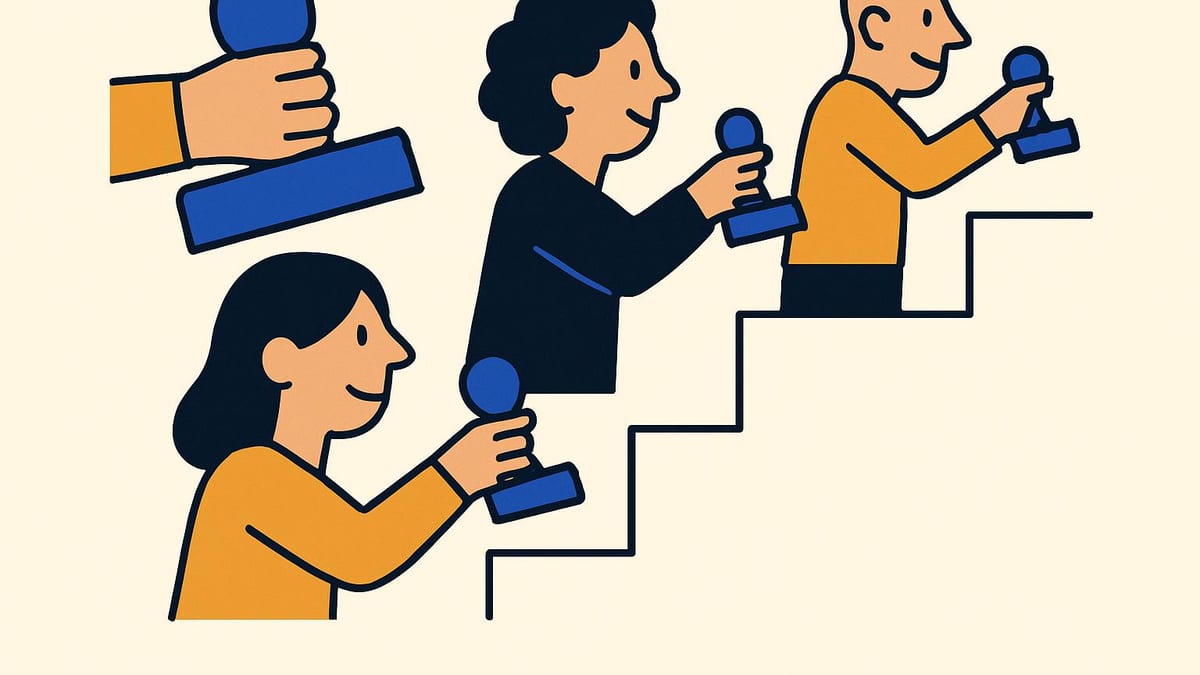
Rules make the first part of the climb slower and the part above it safer. Banks, insurers and healthcare organisations carry approval cycles, audit trails and a supervisor who reads along. That costs months at the start. It also means you are forced to build explainability, logging and human oversight into the design, and that is exactly what customers and regulators will ask every competitor for later. You arrive later and you arrive with the paperwork already done.
Why business customers are easier to read
Purchasing in business markets is documented better than any consumer decision, which makes it easier for a machine to read. Specifications, tenders, contracts, order histories and delivery terms all exist as structured text. A consumer buying a jacket leaves a feeling behind. A procurement manager leaves a file. Agents work with files.
That makes business-to-business more exposed than people assume, not less. The relationship with the account manager is real, and the comparison that precedes it is now machine work.
Whether your people pull with you
Fear and staff shortage pull in opposite directions, and you have one of the two. Where people expect to lose their job, adoption stalls quietly: the tool is used once, then worked around. Where vacancies stay open for months, the same tool arrives as relief and spreads on its own. Find out which of the two you have by asking the teams directly, and build your rollout on the answer.
Age and phase matter in the same way. Young companies build. Older ones unlearn first, and that takes a season longer. Size decides the distance between the person who decides and the person who does the work. The public sector runs this identical climb on the steepest terrain there is.
What you do on Monday
- Write down your zero: list the customer processes that already run end to end in a system.
- Move one decision down a level this week and let that team run a test without asking.
- Pick one business process where your customer's purchasing is fully documented and see what an agent could read there.
- Ask three teams whether they feel relief or fear about AI, and design your next step around what they say.
- Put your regulatory requirements in the design brief now, so your later stages inherit them.
Knowing your terrain is useful once you turn it into a sequence. The CX+AI Maturity Check gives you a reading of where your zero sits and what the next step is, and the book CX+AI describes the route that sits underneath every version of it. View the materials