

What the customer feels in four messages
Open your own assistant on Monday morning and send it the question your customers ask most. Count the messages until you have a usable answer, or until you want to leave. Nearly three in ten consumers call interacting with AI the most frustrating part of doing business with a company. That frustration gets built in, one message at a time.
Roughly eight in ten consumers would rather deal with a person. The same group also says they would rather solve the problem themselves, two thirds of them, which tells you what they actually want: a fast answer without a queue. Your job this week is to design the route to that answer.
Fix the handover first
Five in six customers have to repeat themselves when the conversation moves from AI to a person. That is the single cheapest repair in your journey, and almost nobody does it first because it sits between two teams.
Take one journey. Follow a conversation from the bot into the contact centre and write down everything the agent does not see: the question, the account, the steps already tried, the mood. Then make that package travel with the customer. You are not rebuilding the bot. You are moving data across a handover that already exists.
The handover is where your customer decides whether this company listens.
Put the human option in plain sight
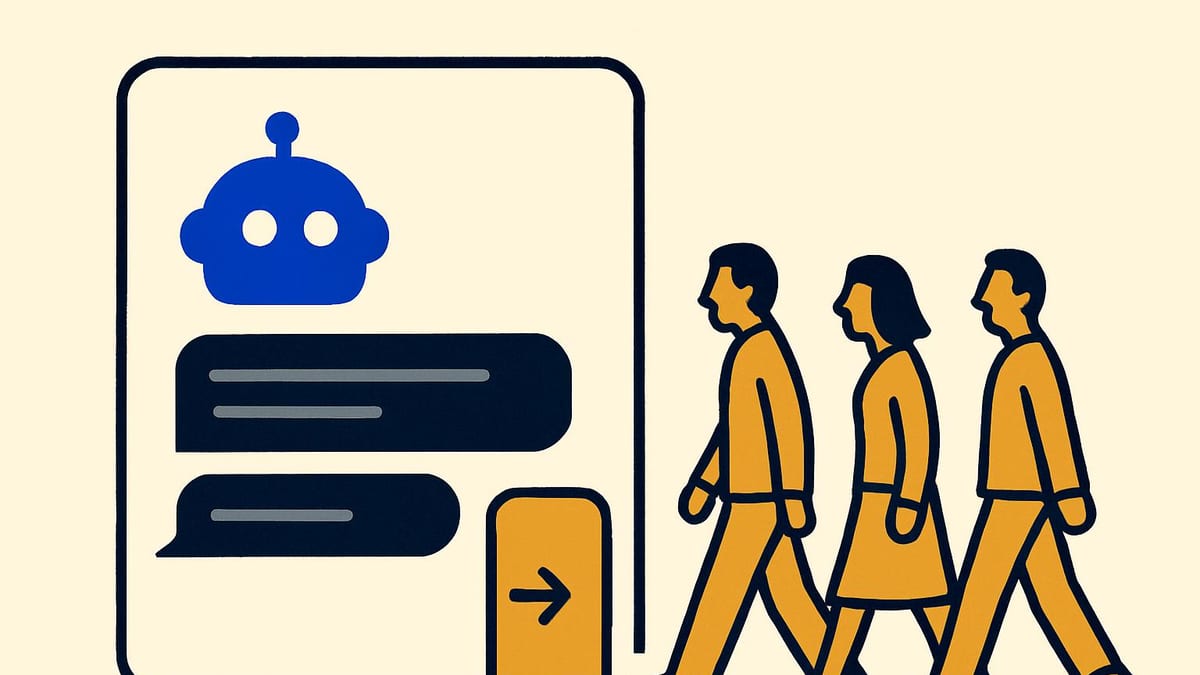
Around nine in ten people want the option to speak to a person at all times, and nearly three quarters walk away from an AI that hides it. Visible escalation keeps customers in the conversation instead of pushing them to the cancellation page.
Put the route to a human in the first screen of the chat and keep it there. Decide, in writing, which situations go straight to a person:
- a complaint about money already paid
- a second attempt at the same question
- anything with a deadline the customer cannot move
- any signal of distress or vulnerability
Count resolution, not containment
Containment tells you how many people the bot kept away from an agent; resolution tells you how many got what they came for. Accenture found that AI-only interactions fail roughly two fifths of the time, and resolution rates across the industry sit around forty percent.
Report both numbers side by side from this week on. The gap between them is your actual backlog. Pick the three intents with the widest gap and rewrite those flows before you add a single new use case.
What to do with the gap
Read fifty transcripts from the worst intent yourself. Not a sample report, the transcripts. You will see the same four or five dead ends, and most of them are missing content or a missing permission, not a missing model.
Say that it is AI
About half of consumers believe they can tell when they are talking to AI, and among younger customers that rises to two thirds. Labelling the assistant costs you nothing and removes the suspicion that colours the whole conversation.
Give the assistant a name, state what it can do, and state where it stops. Customers forgive a bot that admits its limits within one message.

Point the assistant at your own people
Xanterra reached containment around three quarters, and above eight in ten at Glacier, by treating the assistant as part of the service and not as a wall in front of it. The assistant they built for their own employees delivered millions in extra revenue, because staff could answer on the spot instead of looking things up.
Your agents are the easiest first user group. They tell you what is wrong, they tolerate a rough first version, and every answer they find faster lands with a customer the same day.
What you do on Monday
- Send your own assistant the top customer question and count the messages to a usable answer.
- Make the full conversation context travel with the customer into the agent screen.
- Put escalation to a person on the first screen and write down the four situations that skip the bot.
- Report containment and resolution together, and fix the three intents with the widest gap.
- Give the assistant to your own agents this quarter and collect what they report back.
Designing the experience is the second pillar of the CX+AI method, and the handover is where most teams find their first win. The CX+AI book walks through the pillars with the templates for each step, including the as-is and to-be journey maps you need for this work. Bekijk het boek