
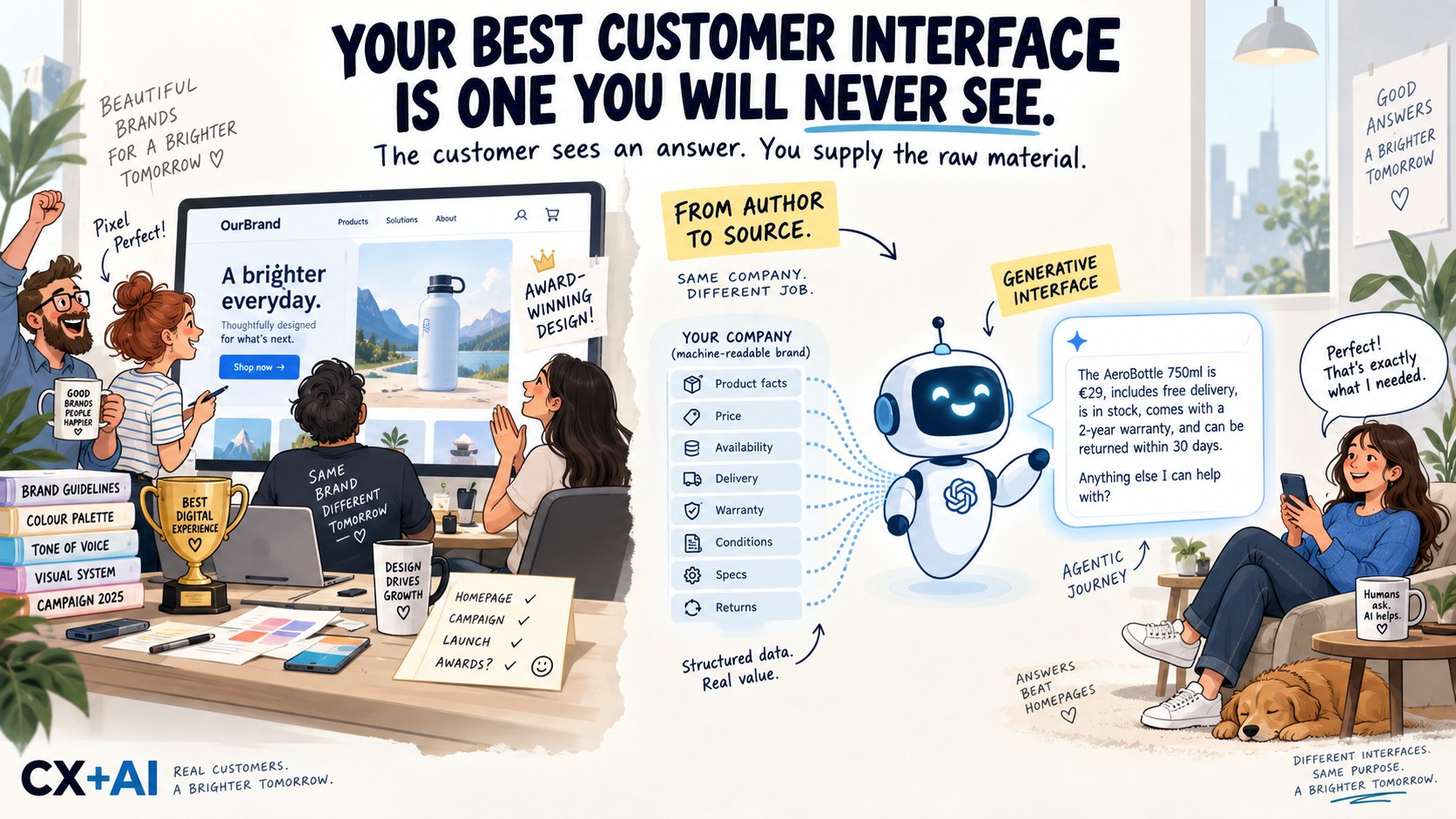
Your Best Customer Interface Is One You Will Never See
Somewhere in the next few quarters, a machine will read your company on behalf of a customer and decide what to repeat. It will pull your prices, your conditions, your delivery times and your product attributes, weigh them against three competitors, and present one answer. Your brand guidelines, your carefully balanced homepage and your award-winning campaign film play no part in that moment. The customer sees an answer. You supplied the raw material.
That shift has a name worth putting on a board agenda: you move from author to source. For twenty years the interface was a place you owned, designed and measured. It is becoming something that assembles itself per question, from whatever the agent can read and trust. Three disciplines decide whether you are readable: a machine-readable brand, the agentic journey, and the generative interface. Most organisations have staffed none of them.
From author to source
The interface used to be a location, and you held the keys. A website, an app, a store, a service desk. You decided what came first, what came second, and which promise appeared in the largest typeface. Every discipline in marketing and customer experience was built on that assumption, including the budget structure.
An agent does not visit a location. It requests what it needs, from whichever source answers fastest and most precisely, and it composes the result for one person and one question. Two customers with the same need may see two different renderings of your company, neither of which you designed. You did not lose the interface. You changed position inside it.
That has a hard consequence for anyone measured on quarters. Traffic, sessions and conversion on your own surfaces describe a shrinking part of the demand that reaches you. Presence in an agent's answer becomes the number that matters, and presence is earned by being legible, consistent and verifiable at the moment of retrieval.
You are the raw material for an interface you will never see.
A brand a machine can read
Your brand now needs a version that a machine can parse without guessing. Not a tone of voice document, not a colour palette, not a set of principles that a copywriter interprets. Facts in structured form: what the product does, what it costs, what the conditions are, what is in stock, what the service window is, what the warranty covers, which claim is substantiated and which is marketing.
The human interface rewarded the appearance of quality, and the agent rewards the fact of it. A page can look authoritative while the underlying data is three months old. An agent checks the underlying data and nothing else. Beautiful surfaces with stale facts read as an unreliable source, and unreliable sources get cited less.
What a machine-readable brand actually contains
- Product and service facts in a structured, addressable form, with one owner per field
- Prices, conditions and availability that update at the same moment everywhere they appear
- Claims separated into verifiable statements and positioning, so an agent can quote the first and skip the second
- Identity and reputation signals that let an agent recognise you as the legitimate source
- A clear statement of what an agent may retrieve, act on and transact, and under which terms
None of that requires a new campaign. It requires someone whose job it is, with a budget line and a quarterly target.
The agentic journey
The customer journey you mapped assumed a human being with attention, patience and eyes. Awareness, consideration, preference, purchase, service. Every step was a moment to persuade. An agent compresses that sequence, executes several steps in parallel, and treats persuasion as noise.
The agentic journey has a different shape. Discovery becomes retrieval. Comparison becomes a calculation across sources. Preference becomes a scoring of fit against stated criteria. Purchase becomes a transaction your systems either accept from a machine or refuse. Service becomes a question of whether an agent can resolve a case through your interfaces without a human intermediary on your side.
Map it as a journey with an agent as the acting party and the differences become operational immediately. Where does an agent hit a login wall it cannot pass? Where does it need a phone call? Where does your checkout reject an automated request? Each of those is a point where the journey ends and a competitor's begins, and each one sits in a system that somebody in your organisation already owns.
Two questions are worth asking about every step:
- Can an agent complete this step with the access and data we publish today?
- If it completes the step, do we keep enough signal to know it happened and to serve the customer afterwards?
The generative interface and the control spectrum
The third discipline is designing an interface you do not lay out yourself. A generative interface composes per question: it selects which of your components, facts and actions appear, in which order, for this one person. Your design work moves from arranging pixels to specifying what may be composed and how.
There is a spectrum of control, and every organisation will sit on several points of it at once.
Controlled. You ship fixed components with fixed behaviour, and the agent may place them. Predictable, brand-consistent, limited in fit. The right choice where regulation, pricing or liability makes variation expensive.
Declarative. You state intent, rules and constraints, and the system composes within them. You describe what must always be true, what is never allowed, which facts must accompany which claim, and which action needs confirmation. The composition varies, the boundaries do not. This is where most commercial and service interactions belong, and it is the hardest to staff because it requires people who can express brand and policy as rules a machine can apply.
Open. The agent builds its own rendering from your data and actions, and you exercise control through the quality and completeness of what you publish. Maximum reach, minimum grip on presentation. Reasonable for information and comparison, demanding for anything that carries a promise.
Deciding where each interaction sits on that spectrum is a governance decision, not a design preference.
Make that decision deliberately per interaction type and you get something a board can review: a register of where you accept variation, where you require confirmation, and who signs off on each.
Three standards, and why your roadmap changes
Three standards are doing the connecting work, and each one opens a different door into your company. One connects agents to tools and data, which is how an agent reaches your systems and your facts. One connects agents to each other, which is how a customer's agent negotiates with yours. One connects agents to users, which is how the result gets rendered in front of a person.
Read that as an architecture question with a commercial deadline. The first standard determines whether your data and actions are reachable at all. The second determines whether you can represent yourself in machine-to-machine conversations rather than only respond to them. The third determines how much of your own presentation survives the last step.
The practical move is to treat all three as interfaces you support on purpose, with the same rigour you apply to a payment integration: documented, monitored, versioned, owned. Support them and you show up in answers you did not build. Skip them and you rely on whatever an agent can scrape from surfaces built for human eyes.
The team of thirty and the team of none
Most organisations have a brand team of thirty people and a structured data team of nobody. That ratio was correct when the interface was a place you designed. It describes an organisation aimed at an audience that no longer does the looking.
Correcting it costs less than a campaign. Move a small number of people and a defined budget to the ownership of machine-readable facts, give that team a place in the same governance where brand decisions are made, and give it one quarterly number: the share of your commercially relevant facts that are structured, current and retrievable. That number rises within a quarter, and it rises visibly.
The thirty people stay valuable. They now write the rules that a machine applies at scale, define what must always be true in a composed interface, and decide where variation serves the customer. That is more leverage than a homepage ever gave them.
What you do on Monday
- Name one owner for machine-readable facts, with a budget line and a quarterly target for coverage, currency and retrievability.
- Walk one high-value journey with an agent as the acting party, and list every step where it needs a human on your side.
- Place your top ten interaction types on the control spectrum, decide which sit at controlled, declarative or open, and record who signs off.
- Add support for the three connecting standards to the next release cycle, documented and monitored like any paid integration.
- Put one slide in the next board pack: share of answers where we appear as the cited source, measured monthly from now on.