

The voice bot that made the phone ring more
In August 2025 Commonwealth Bank of Australia put 45 customer service jobs back. The bank said its assessment "did not adequately consider all relevant business considerations", and it had earlier said a new AI voice bot reduced call volumes by 2,000 a week. Reporting on the episode described the opposite effect in practice, with call volume rising rather than falling, after which the cuts were reversed.
That is the moment worth sitting with, because the technology worked roughly as sold. Chapter 14 of CX+AI describes ten shifts in thinking, and none of them is technological. This is part one of two: here is the case, next time what you do with it.
What the bot actually exposed
A voice bot does not create a routing problem, it inherits one. Calls rose because the work behind the call was unresolved: ownership unclear, knowledge scattered, handover undefined. AI arrived, multiplied all of it, and sent the result to the customer.
That is the mechanic the chapter names. AI is a multiplier, not an addition, and a multiplier on zero gives zero. Six blocks carry a transformation and they multiply rather than add: strategy, data, way of working, governance, technology, and culture and skills. One zero makes the whole thing zero.
Rollback is now the normal outcome
Pulling an agent back out of production has become a common management act. Sinch published a global study in May 2026 finding that 74 percent of companies using AI-powered customer engagement had rolled back or shut down live AI agents because of governance problems. The detail underneath matters more: firms with the most sophisticated governance frameworks reported rollback rates as high as 81 percent, above the average, because stronger monitoring surfaces failures others never see.
Read that the way your CFO would. The better-run organisations rolled back more often. They could see what was happening.
Organisations overestimate where they stand, and the ones that measure properly are the first to find out.

What the customer feels first
Every AI implementation is a wall or a door, and the customer feels the difference within four messages. Klarna's CEO told Bloomberg in 2025 that the company was hiring human agents again, that AI was cheaper but delivered lower quality, and that customers should always be able to reach a human. Gartner polled 163 service leaders in March 2025 and 95 percent said they plan to keep human agents.
The customer is not rating your model. He is deciding whether this company is worth the effort of a second attempt.
Who has to move
The layer that has to lead adoption is the layer AI threatens most. Middle management owns the routing rules, the exception handling and the workarounds that keep a broken process upright. Those workarounds are invisible on a slide and decisive in production.
For a board measured in quarters, the split is this:
- Installing buys the cost base of this year.
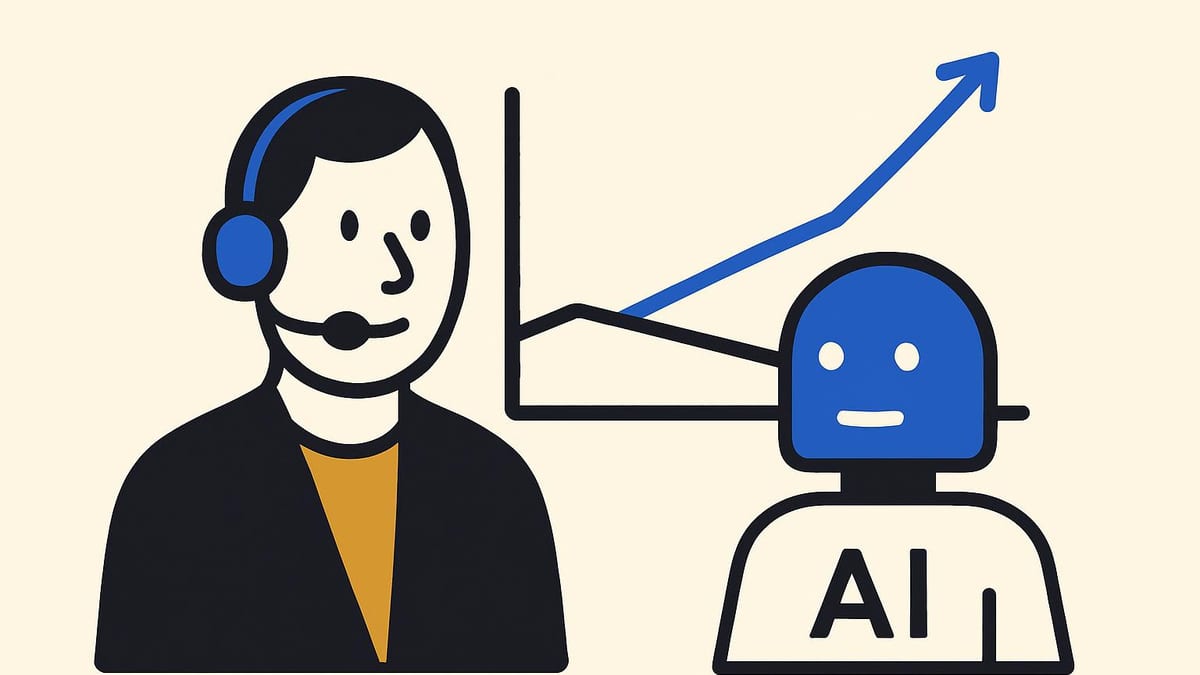
- Integrating buys the slope, and slope compounds.
- Maturity runs over five levels, from ad hoc to self-improving, and levels cannot be bought or skipped.
What you do on Monday
- Take one live AI use case and name the six blocks behind it. Score each one honestly and find the zero.
- Ask your service lead for the volume data before and after your last deployment, not the deflection rate.
- Walk four messages of your own customer journey as a customer, and write down where you would have stopped.
- Give one named owner the authority to pull an agent out of production, and tell the organisation who that is.
Chapter 14 sets out the ten shifts and where each one bites. The AI Maturity scan takes the same six blocks and gives you a score per block, which is the fastest way to find your zero before the next deployment does it for you. Bekijk de materialen